
Magazines & Publishing
“I’m actually pretty brief, by comparison.” — Talking Interviews with Eric Swisher of The Chrome Ball Incident
Question and answer interviews have long been a predominant format for written skateboarding journalism. To unpack how they became so ubiquitous and decipher what, exactly, makes for a good one, the script was flipped on Eric Swisher (“Chops”) of the esteemed blog, The Chrome Ball Incident.
by Farran Golding
photo by Jaime Owens

“Chops and Speedway sit down for conversation.”
Run me through your background in journalism.
I grew up writing but I never took it seriously. I went on to get a psychology degree, but I was too far in by the time I realised I didn’t like it so I finished that and went to grad school for journalism.
In my twenties, I started Chrome Ball as a side project. I was doing a lot of graphic design, referencing skate stuff I’d seen growing up. I started scanning ads and the website was this weird thing which I never even thought about catching on. You don’t start these things thinking you’ll still be doing it years later. Within a couple of weeks I got emails from Andy Stone and Andy Jenkins which made me think, “Oh, I guess there’s something to this” so I kept it going. Chrome Ball was just scans of old ads and photos that I was stoked on. It was strictly an exercise in copyright infringement, I suppose. Not that I intended for it to be.

The Chrome Ball Incident’s masthead. Illustration by Andy Jenkins
About two years in I thought about adding another dimension. I sorta knew John Drake so I reached out on a Hail Mary and he was Chrome Ball Interview #1. Luckily, people who read the site liked what I did and connected me with people who they knew I could possibly interview. The first twenty-or-so interviews all came from this one guy, Jon Constantino, who used to skate Embarcadero. I didn’t meet him until years later but he hooked up the majority of those early interviews. I owe so much to him.
Honestly, I don’t like a lot of my early interviews because I didn’t know what I was doing.
I’m grateful those first people agreed to be interviewed but, looking back, I’d like to do them all over again. A few of them I actually have.

John Drake via the Alien Workshop archive
Considering the Alien Workshop reference with ‘Chrome Ball’, I figured John Drake being your first interviewee couldn’t just be a coincidence.
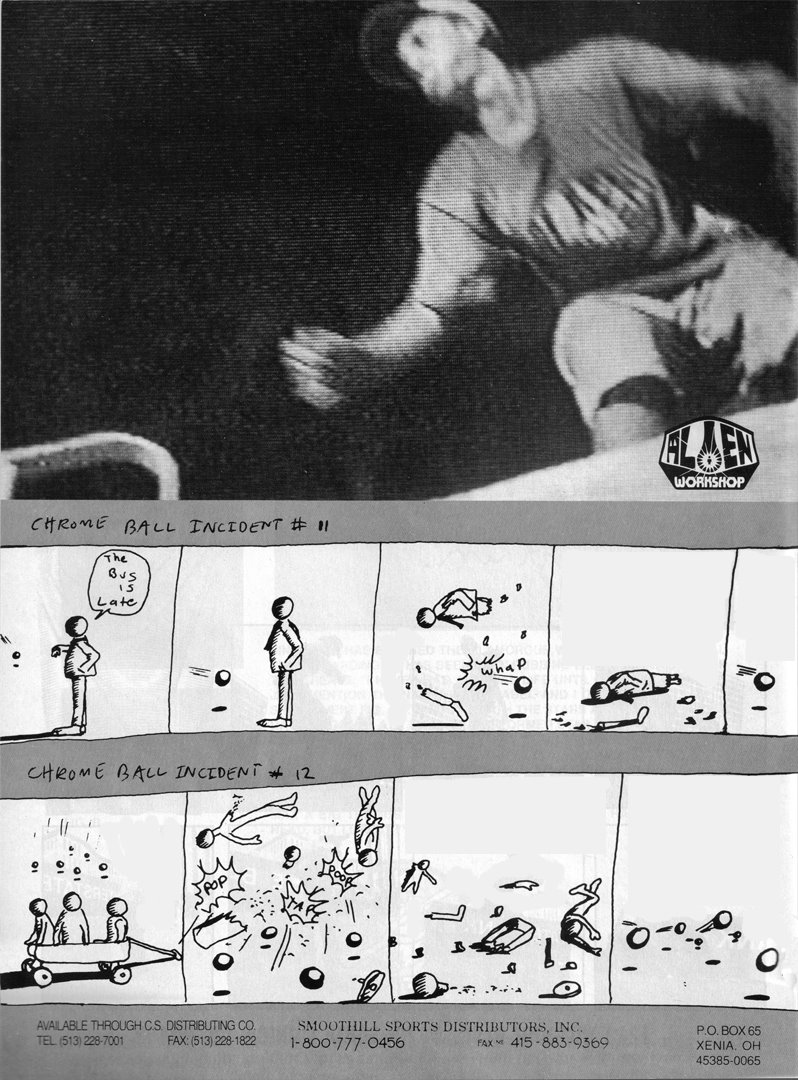
How it worked out was: my local skate shop as a kid, which was about an hour away, was called Iguana Sportgear. John lived in that town and it’s also where Don Pendleton went to school. They’re older than I am. Don actually worked at that shop and used to grip my boards when I was 11. So John Drake and Don Pendleton have always been in the periphery of my skateboarding experience, somehow.
“You could tell he put thought behind each of these questions and truly wanted to know the answer which has always been my philosophy with interviews.”
Can you remember the first interview which made an impression on you?
I was in 6th grade and there was a Tony Hawk retrospective in Transworld, in ’89, the same issue as the flatground article with Steve Ortega’s 360 kickflip. Looking back on it now, it has totally influenced everything I’ve done whether it’s conscious or on a deeper level. It’s super long, which is my curse, it’s a year-by-year retrospective but there’s also lifestyle stuff. Tony at his house, a page where he just lists his favourite movies and bands; I’d never seen that before..
Just seeing, like, “Oh, Tony likes Naked Gun!”
There were a couple of David Lynch movies which I checked out because of it. It was super nit-picky but it was beyond: “So Tony, tell me about this?” So many interviews back then could just be throwaway questions. It felt like there was a lot of weight to this. Garry Scott Davis wrote it and you could tell he put thought behind each of these questions and truly wanted to know the answer which has always been my philosophy with interviews. I try not to ask a question unless I genuinely want to know the answer.

Tony Hawk, TransWorld Skateboarding Retrospective, 1989. Words by Garry Scott Davis, photography by Grant Britain & Otis “O” Bartholamue, design: unknown.
Did you speak to John Drake in person for that first Chrome Ball interview?
No, I was living in Pittsburgh at the time and I think he was living in North Carolina. That was email style: send a list and pray for the best. The first interviews I did were strictly through email because I didn’t really know what I was doing and I was probably too intimidated to talk to them over the phone to a degree.
My first interview where we spoke on the phone was with Sean Sheffey, he’s Chrome Ball Interview #14. I’m a gigantic Sean Sheffey fan but he’s not the type of guy who you’re going to send an email to. I hooked that up through Sole Tech and we talked while he was riding around Oceanside on his bike. I was nervous but he was so nice. After that I tried to never do an email interview again unless I really had to.
Some people just refuse to get on the phone but there’s a major difference between email and speaking to someone. It’s a more personal experience and their humanity shows versus: “Here’s three sentences. Type, type, type. Send.” That’s when I bought a tape recorder, because I had to figure it out.

Mark Suciu, varial heelflip at Love Park, Philadelphia for a ‘Cross Continental’ era Habitat ad. Photo by Zander Taketomo, design by Joe Castrucci.
I’ve always felt that what you do is underpinned by a historical relevance or cultural value to a person, their skating, and their story. Someone like Mark Suciu fits the mold of a Chrome Ball interviewee even though he’s a ‘contemporary’ skater. To me, anyway. What’s guided your choice of interviewee over the years?
Honestly, it’s whoever I think will be interesting, fun or have a unique angle. Lately I’ve been trying to challenge myself with younger guys but it seems a lot of people don’t want me to interview anyone under the age of 40. But you don’t want to do too many of the same stories, you know? Like, “Tell me about Embarcadero” again…
It’s funny, so many of these skaters from the ‘90s are almost a mystique model. Their careers were shorter, they had two parts and then were gone. If you look at Mark, Louie Lopez, Bobby Worrest, granted they’re still young but they’ve done so much. Mark has had the productivity of five ‘90s pros combined.

“Mark has had the productivity of five ’90s pros combined.”
People hold someone like Dan Peterka in high esteem, and I love Dan Peterka, but he had one video part and a couple of ads and that was it. In, like, 1992. He was in and out, you know? But if I interviewed Dan Peterka, people would be like, “Of course he’s interviewing Dan Peterka, he had that one part in ’92!” But when I interviewed Mark, a few people were like, “Really? You’re interviewing Suciu? He’s so young.”
Well, yeah, but he’s been around for over a decade and the scope of his career is incredible. I loved interviewing Mark because he has an answer for things. If you ask him the most detailed question, he’s probably already thought about that and he can relay his thoughts to you. It’s not, “I don’t know man, I was just skating.” That answer drives me nuts.
A lot of people will know the reason for something but won’t say it because they don’t want to sound crazy or full of themselves. That shouldn’t be the case with an interview. If someone asks you a question, obviously they’ve picked up on something you intended so just say what your thought process was.
Do you think studying journalism has been beneficial to the way you write about skateboarding?
I got my Master’s in 2001 and it’s been completely dumped on its head. The entire model and paradigm has been completely reversed since then. The writing is the same for the most part but, as far as the business model goes, magazines are in the toilet. I tell my fiancé all the time that it looks good on paper that I’ve got my degree but I don’t use that much from it. Honestly, everything I’ve gotten professionally has been from doing this blog on the side. I worked at Nike for a while and they didn’t even know I had a degree. I was just “the Chrome Ball guy.”
Something that crosses my mind about skateboarding journalism is if you have to be a fan of a person to interview them. Because Chrome Ball is so personal, I guess that doesn’t apply here?
With Chrome Ball, it’s up to me to figure out what I want to do. I’ve done stuff for magazines and turned down a couple of things where I just wasn’t feeling it. I don’t think you have to be a fan, you just need a genuine interest in their story or point of view. It helps if you’re a fan but it’s not necessary. I’ve interviewed people that I wasn’t a straight up ‘fan’ of, but honestly I kind of became one after speaking to them.
“I worked at Nike for a while and they didn’t even know I had a degree. I was just “the Chrome Ball guy.”
How much preparation goes into an interview and what’s your process?
I’ll reach out to someone via a friend, email or sometimes “slide into the DMs” as the kids say. If they’re not into it then that’s perfectly fine. When they’re down I try to watch all of their parts at the minimum and go over any ads I can find whether it’s on my side or through Instagram. Obviously there are the ‘trick ads’ but sometimes you’ll get an ad that’s more inspired by their personality which can provide something good to ask about.
I read any interviews I can and try not to cover too much of what already has been; when I started out there weren’t that many people into interviewing and now there’s podcasts and a lot of people doing interviews. It’s typically looking over stuff for a day or two while making little notes and from those I make a full list of questions then I hit them back to schedule a call. After that it’s transcribing and editing it down to a floating word count which never seems to work out.


Andrew Allen for Hockey, based on ‘Pacific 1967’ by Alex Colville, which inspired a scene in Michael Mann’s Heat, and channels Henry Hill in GoodFellas for a Hockey ad.
“Skateboarding comes first but their personality and lifestyle always bleeds into their career. They almost become one and the same.”
What balance do you try to present between the subject of skateboarding and your interviewee’s life outside of it?
Because I don’t know a lot of these people, skateboarding comes first but their personality and lifestyle always bleeds into their career. They almost become one and the same. Take Andrew Allen, there’s all of these movie references which lends to his identity and career. The GoodFellas shirt, Point Break…
I veer on the side of skate-nerdery. If some guy said a throwaway line in a video from twenty years ago then I’m going to ask about that stupid line. You never know unless you ask. Sometimes it’s a total airball and sometimes there’s something sincere there which maybe no-one has ever asked about before. If the answer sucks you can just edit it out but, at the very least, if you go to that level of detail I think it’s flattering and it helps the interview. If I remember something and want to know the answer then I feel there are people out there who will also remember and want to know the answer. I put the ‘cool guy’ shit on the shelf a long time ago. I’ll own the skate-nerd thing.

How important is it for an interview to have an educational angle separate to skateboarding? Whether it’s as simple as getting turned on to a new book, film or some music, or learning about something more challenging entirely?
Each interview is different. Some of these careers took place so long ago and the media landscape has changed so much; maybe the person has never had an interview before so I just want to get their story. It depends on the interviewee’s personality. Someone might be a storyteller whereas someone might be more political in nature and you want to lean into it. It’s wherever the conversation goes from your base of questions.
I just want to tell someone’s story as honestly as I can and maybe illuminate a side that people can benefit from. I love letting people discover albums, movies and books through those interviews and if it happens then that’s great, I always try to include that stuff. As a kid I discovered Public Enemy because Natas wore a Public Enemy shirt and that changed my life. It’s those breadcrumbs people can pick up which mean a lot especially when they’re in their teens or twenties. Maybe it’s different now because of the internet.


Opening spreads from Natas Kaupas’ TransWorld ‘Pro Spotlight’ interview, 1989. Photography by Tod Swank & Grant Brittain, designer unknown. Full interview available via Chrome Ball Incident #102: Respect The Architect
“I used to be the “long guy”, but now, as far as podcasts go, I’m actually pretty brief, by comparison.”
There’s something of an inherent humility in skateboarding… or maybe false modesty is more accurate [laughs]. But can humility exist if you put somebody in a situation where they’re being directed to talk about themself for the most part?
I’m in a different situation because a lot of “my guys’ have long since retired so they’re just happy going over some nostalgia with a fan. A lot of my subjects are surprised anybody even cares so asking about these minute details, again, it’s probably pretty flattering. With the younger skaters I’ve interviewed, I think being a professional skateboarder in the 2020s is much more of a career path now. The pros today are different from how they were in the ‘90s because there’s more money involved and younger kids are more media savvy in general. They all have their own channels whereas in the ‘90s you’d have Guy Mariano with a photo in the mag this month. We might not have heard from Guy Mariano again for another two years.
“But he had that one photo and it was sick!”
Now, there’s so much content that I think it’s just a different mindset.


“Mystery is style,” writes Joel Patterson for the introduction of Guy Mariano’s TransWorld ‘Pro Spotlight’ interview, 1995. Available to read via Chrome Ball Incident #646: The Book of Life.
How has your style as a writer developed over the years?
My word count just keeps getting longer and longer. I started out aiming at 4000 which, at the time, people thought I was writing War And Peace. Now I like to be around 8000 and I say that with a grimace. I don’t normally get there anymore because I feel things have changed so much. I used to be the “long guy”, but now, as far as podcasts go, I’m actually pretty brief, by comparison.
People have asked me, “Why don’t you do a podcast?” I’d be terrible at it. I get nervous just thinking about it. We can throw some words on the page, craft it and have a little more control in that side of the presentation. I interviewed Jason Dill one time for Chrome Ball and we just recorded the phone call because that’s what he wanted to do. Here’s the thing with me, I know how Jason Dill sounds. Jason Dill sounds all cool and he’s doing his thing and then I hear me bumbling around. I’m not a podcast dude. I wanted to do what Tim [Anderson] does with Bobshirt, where he types out what he says but I couldn’t do that because it’s Tim’s thing. He basically marries a podcast with print [writing] and that isn’t easy. You’ve got to keep looking at the screen to get the questions and I love that. You’re not folding laundry during Bobshirt.


Chrome Ball Interview #77: Jason Dill
Do you think Chrome Ball’s reputation helps you and the interviewee feel more comfortable from the get-go?
The first couple of questions are always kind of guarded and that’s not just skate interviews, that’s interviews in general. But asking detailed questions about something they’ve put a lot of time into has got to be flattering for someone who you’ve never met. I think it opens it up. I try to keep it light and fun. I never thought I’d be able to talk to these people and I’ve tried to never lose sight of that fact. I always tell my fiancee this. Something will happen and I’ll be like, “Man, fifteen year-old Eric would be stoked right now.” I try to keep that lens.
“[Writing] is like skateboarding in that what you do off your board is important … It’s the guy who comes [to the park] for an hour, kills it, then goes off and does something interesting which feeds into that, you know? I feel it’s the same with writing.”
To what extent does what you read and write outside of skateboarding influence your approach?
I’m a copywriter professionally. I was at Nike – granted I was in SB but I did a lot of non-SB stuff too, then I worked with Apple for a year or two which was pretty amazing and I interviewed a lot of non-skateboarders. And I was at Stance for a couple of years. I find that writing about other things informs the skate stuff, in a way.
At Apple I interviewed some guy who trains birds in Mongolia, we had to have a translator and I had to wake up at a crazy time for it. There was this wild range and it’s like skateboarding in that what you do off your board is important. No one likes the guy who “trains” at the park twelve hours a day. It’s the guy who comes in for an hour, kills it, then goes off and does something interesting which feeds into that, you know? I feel it’s the same with writing.
In recent years skateboarding has attracted more attention from non-skateboarding publications. What are your thoughts there?
As long as it’s done right then I think it’s good. I don’t even want to say it depends on who is writing it, it’s just how they go about writing it. There are pieces written by skateboarders which I cringe at. There just has to be an honesty and fairness to it, I’m not going to say, “So-and-so can’t even kickflip!” because that doesn’t matter.
I think skateboarding needs that [wider documentation]. God knows a Chrome Ball interview is not going to convert anyone from outside of skateboarding because they’re going to think “What the hell is this guy talking about?” If you can write a welcome mat for people to get an interesting look inside this somewhat guarded subculture then that’s a positive thing. Just don’t kook it.
“If you can write a welcome mat for people to get an interesting look inside this somewhat guarded subculture then that’s a positive thing. Just don’t kook it.”
The Q&A interview is a time tested format for documenting skateboarding and certain incarnations of them have become prestigious. A Transworld ‘Pro Spotlight’, getting a Thrasher cover and an accompanying interview, even a Chrome Ball interview feels appropriate for those who have a certain legacy, as I mentioned earlier. Where do you think the Q&A interview stands amongst skateboarding media nowadays?
So many people are conducting interviews now that it’s good to stand out with a nice substantial longform piece. I always went with Q&A because I wanted to get myself out of the way as much as possible. I started doing interviews in 2010 and my whole thing was that no-one wants to hear what I have to say. I’m just a surrogate for the audience and hopefully asking what they want to know. My questions are the first to get whittled down to their basic point. I don’t like when interviewers take over the interview and make it about them. That drives me nuts and it’s one thing I’ve never wanted to do.
I think it’s a great albeit crowded time for Q&A interviews and ultimately that’s a good thing as long as people do a good job. Some skateboarders will only do a handful of interviews, ever, so you want those interviews to be great. It’s terrible when some guy has had only one interview in the past ten years and that interview sucks. It’s such a missed opportunity. I’m not saying I should be the person interviewing in those situations. I just want whoever it is — hopefully it’s you, Bobshirt or The Bunt — but whoever it is, they do a good job. I think that’s all anyone wants: not something half-assed.
“If all you’re interviewing someone for is to ask that one gnarly question and nothing else, then you could very well just be an asshole.”
How do you navigate difficult questions and topics? Do you give a heads up?
It’s funny, I’ve never had any gnarly questions for the people who have asked to see them first.
I want to be respectful to the interviewee but also respectful to the audience and do the best that I can. I feel I’ve asked a few things which people wanted to talk about but never had the chance to do so for whatever reason. For the most part it has been easy because the interviews are over the phone so they can’t punch me out. Unless you know the person you don’t start out with a gnarly question and if all you’re interviewing someone for is to ask that one gnarly question and nothing else, then you could very well just be an asshole. That’s not what I try to do.
There’s been a couple of times where I’ve had such a question and I don’t go straight to it. I ask about it in the framework of their timeline. You build that respect and trust, you establish that you are a fan and that you’re asking about the subject as part of the canon. There’s definitely a point where it’s like, “Alright, here we go…” and you don’t know if they’re going to hang up and the whole thing is a wrap although that’s never happened to me before. If your intentions are good, people will recognise that and how you’ve gone about it.
Where do you stand on copy approval?
I almost always try to get approval, not that there’s anything scandalous but sometimes you just hear something wrong. The interviews I’ve posted without approval have always been the most innocent. I try to be respectful and typically always offer it before the interview gets published.


Lennie Kirk for Alien Workshop, Time Code era. Photography by Mike Blabac, designs by Mike Hill.
What’s your stance on publishing something which wasn’t said “off the record” but could be problematic?
Oh man, the only time I remember this is when I interviewed Lennie Kirk. He made it known that he felt God was speaking through him and for me to edit any of that was an “abomination to God” so that was a pretty heavy situation. When I started that one out I thought, “Lennie’s an amazing skater and he’s quite a character.” I feel like I’ve fed into that “legend” early on, but over the course of the interview it quickly became [a realization of] “There are deeper issues here which people are lightly glossing over.”
If you’re going to interview someone, you have to present their point of view, be it good or bad. That’s why you’re interviewing them. You don’t have to agree with it. There were a lot of things in there which I didn’t agree with but I asked to do the article. A magazine guy could say: “We will never print that” for whatever reason, but Chrome Ball is all on me. I had to choose to put that out there, for better or worse, and I got a lot of flack for that one.

Ronnie Bertino, Chrome Ball Interview #5 and redux for Chrome Ball interview #129.
Is the blogspot format deliberately archaic? Not that it’s a bad thing…
Oh, it’s totally a bad thing. It’s clumsy, it’s ugly, it’s so 2005 but I got lucky in that it works with the reminiscent subject matter. I’d love to have a proper website but there’s so much crap on there and I don’t really know how to go about making a website. It’s laziness on my part to be honest. “I could make a website but I’d rather go interview this dude instead…”
“There’s an access piece to every interview of finding that person and getting them to listen to you ask goofy questions for two hours over the phone”
You’ve contributed a few columns to magazines here and there, had a little guest spot with Transworld and now a Chrome Ball interview in every issue of Closer. I was going to ask if an outlet you’re working for shapes any aspect of an interview. But does that question have any bearing even though your work is always ultimately a Chrome Ball interview?
Like I say, Chrome Ball is just me and you start to feel like you’re in a bubble a lot of the time. Not only that but there’s an access piece to every interview of finding that person and getting them to listen to you ask goofy questions for two hours over the phone. I met Jaime Owens about ten years ago, he’s been a good friend and a solid supporter of what I do going back to when he was at Skateboarder. And a few years ago, I ended up moving to the same town in California that Jamie lives in.
I’d been helping Jaime with a few things at Transworld over the years. First and foremost, because I was always a Transworld kid growing up and felt honored to contribute to that lineage. Because that’s how I started Chrome Ball, right? Scanning my old magazines. Also, Jaime being my friend, I just wanted to help him out, too.
Closer came about after he left Transworld. He’d been trying to figure out what to do next when he came up with the idea to start a magazine. Honestly, I thought he was nuts, but I wanted to help him out where I could. I knew if we could just get people to see the magazine, they’d be hyped. It’s just that magazines are a pretty tall order in 2024. It’s been great helping him out, though. He basically lets me do whatever I want and I’m stoked to see my work in print and not on that archaic blogspot. Plus, he’s been able to get me interview subjects that I wouldn’t have been able to get on my own, like Rick Howard. Jaime’s doing an amazing job.
What makes for a good interview?
As long as it’s entertaining and reveals something new. I feel that’s the base level. No-one wants a snoozer.

Interviews can add or diminish mystique and that presents a funny duality. The person who shies away from the spotlight can, arguably, be just as interesting as an engaging skater who is happy to talk. Interviews are the backbone of any kind of journalism, whereas the way skateboarders crave knowledge feels unique. Does that explain why interviews are so omnipresent in our culture?
Interviews are important because skateboarding is based almost entirely on interpretation and personality. It’s what that person decides to do with their board and how that coexists with other ideas and preferences which makes it more like music in my mind versus ball-goes-in-hoop. It’s never objectively “two points”. The people I like to watch skate obviously have a point-of-view and approach things from a certain perspective. It’s that, married with physical talent, which makes a good skateboarder. But I do think it’s the personality bit that’s more crucial. And that’s where the interview comes in. It explores that very thing.
The mystique thing is an interesting one… I remember in the ‘90s, [Eric] Koston was out there killing himself, sometimes with multiple parts a year of incredible skating, and Gino [Iannucci] would have maybe one sick photo every so often yet they were both my favourites, somehow. There are some people who can just make that mystery thing work for them. I’d love to read some blow-out Julien Stranger interview but I kind of hope he never does one. Not just anyone can get away with that, not at all.

Excerpts from Gino Iannucci’s Big Brother interview, 1996. Words by Natas Kaupas and Jeff Tremaine, photography by Rick Kosick, designer unknown. Available to via Chrome Ball Incident #518: Jack and Jane.
Historically, writing hasn’t had the same draw as photography or filming in skateboarding but today everything from various aspects of diversity to niche nerdier subjects are being written about. Mags have dwindled and little grassroots outlets like yourself, Quartersnacks, and so on, have become as respected as some of the biggest magazines were. Do you feel that writing about skateboarding has a wider appeal nowadays?
Honestly, I think it has more to do with distribution. The internet opened all that up to where people feel like their voices can actually be heard, which is why so many more people are doing interviews now.
I never even entertained the idea of interviewing someone prior to the internet because it just seemed like something only people who work at magazines could do. I mean, how would I even have contacted a potential subject back then? Write them a letter from Pittsburgh? Total longshot. And while I’ve always loved zines, they always felt like so much more work for a reach that’s limited to an edition of 50 from Kinkos… Which is what actually makes them even more awesome, in a way.
I’ve always felt like all our little sites are just an online continuation of that zine culture. This shift you talk about would’ve happened way earlier had those works been able to really get out there. GSD’s Skate Fate, Swank Zine and countless others are absolutely incredible, it’s just that hardly anyone was able to see them. They were just so finite.
“I’ve always felt like all our little sites are just an online continuation of that zine culture.”
Skateboarding folklore and history is a pretty verbal tradition where knowledge is generally passed on from our friends or learned from reading interviews. Even as the methods of documenting skateboarding become more sophisticated, with the likes of bespoke books and documentaries popping up more frequently, will the simple Q&A interview forever stand up? What do you think the future holds for the interviewers and journalists?
At this point, I worry more about the content itself. Everything seems to be coming out so quickly, only to vanish within a couple of months. With printed magazines and hard copies having largely fallen out of vogue, a scary majority of our content only exists on a temporary internet cloud. It’s something I’ve noticed with interviewing younger pros,
We’ve archived so much of the ‘80s and ‘90s, even to the point where we’re saving photos that never even ran, but a shocking majority of content from the late 2000s/early 2010s cannot be found. It’s just gone, and that wasn’t very long ago. It’s an interesting time. Because years from now, you’re not going to find a stack of dusty old internet links in your closet, that stuff just won’t exist anymore.