
Story and interviews by Farran Golding
Collages by Templeton Elliott
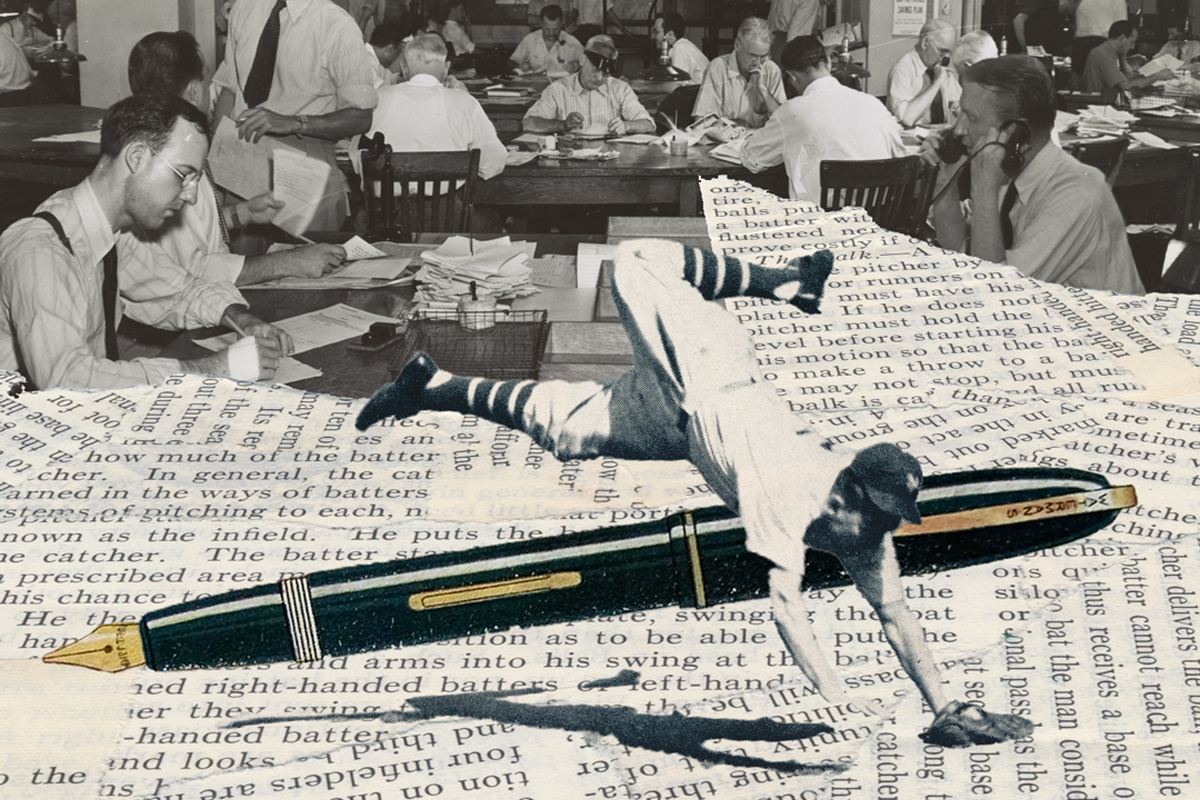
The 1963 book Can’t Anybody Here Play This Game? is a baseball text informed by two men who experienced “pitching” in completely different contexts with vastly different outcomes.
The title was posed by New York Mets manager Casey Stengel, who saw his team bumble through 120 losses, out of 162 games, in their inaugural 1962 season. The Mets set the record for the worst MLB team in history, statistically, which stood until 2024. Stengel’s frustration was expressed to the journalist Jimmy Breslin, christening the aforementioned chronicle, which became one of Breslin’s many acclaimed works. For his columns championing working class New Yorkers, Breslin would win the Pulitzer Prize in 1985 and his legacy is that of one of the great deadline artists of the 20th and early 21st century. Clearly, Breslin knew how to pitch to a newspaper editor more effectively than Stengel’s Mets could launch a ball from the mound.
Not every story begins with a pitch but making it land is the first step towards publication. A unique angle is the inherent draw for journalists and editors alike but sometimes communicating that succinctly and right contextually becomes overwrought when entering unfamiliar editorial territory. (Or when the next paycheque depends on it.)
Pitching to the person running a magazine, website, brand — wherever — is a skill continually refined over the years but requires confidently demonstrating expertise and ability, as much as the vision for a piece, right off the bat. We reached to writers and journalists Cole Nowicki, Ian Browning, Josh Sabini and Claire Alleaume; photographer and photojournalist, Norma Ibarra; documentary maker and videographer, Greg Navarro; and brand manager, Alex White — whose collective resume spans print and online media, regional newspapers, footwear and hardware companies and beyond — for the inside baseball of how pitching to skate publications and brands works for them.

Cole Nowicki
Cole Nowicki, 34, is a writer from Lac La Biche, Alberta, Canada who is based in Vancouver, British Columbia. He has written professionally for twelve years and has contributed to Closer Skateboarding, Thrasher Magazine, Quartersnacks, King Skate Mag, SBC Magazine, Neighbourhood; non-skate outlets including The Walrus, Toronto Star and VICE; and authored the books of Right, Down + Circle which explores the cultural impact of Tony Hawk’s Pro Skater (ECW Press, 2022) and a collection of essays Laser Quit Smoking Massage (Newest Press, 2024). Cole also self-publishes Simple Magic, a weekly newsletter about skateboarding and the internet.

Cole Nowicki, switch crook by Daniel de Amaral
What goes into a pitch, how do you frame the story, and what are the most important things to get upfront?
I try to establish the “why” off the jump. Why does this story matter? Why is it relevant to the current moment and that publication? Why are you the person to tell it?
I pitched a skate piece to the Toronto Star, a mainstream newspaper, about [skater] Fay De Fazio Ebert competing for Team Canada at the 2024 Paris Olympics. De Fazio Ebert was representing the country on the world stage as the youngest athlete from Canada and, I argued, was on the verge of superstardom. Those beats made it into the headline.
The sub-story to all of that was the difficulty Canadian athletes have training in the country due to a lack of resources and facilities. Including something like that gives the story more depth and intrigue than the surface-level bright lights of “child prodigy goes to the Olympic Games”. Then I pitched myself, letting them know that I am a life-long skateboarder with a history of working in skateboarding media, showing that I have the experience and cultural awareness to cover the story properly.
If you’re going to be interviewing folks for a piece and have connections to them, it helps to mention that. It shows the editor you have access to the subject(s) of the story and you can hit the ground running.
When does a story begin for you in regards to pitching? How often do you pitch a story you’re already working on versus something you want to undertake if an outlet is interested?
I’m either familiar with, or do a fair bit of research into, a subject before pitching. You want to be knowledgeable, not just present yourself to be. I’m sure most of my pitches that flopped—especially in my early days—are due to coming off as having too basic a grasp of the subject or not having an interesting enough entry point. Sometimes I pitch stuff I already have a draft of and other times I throw out there what I’d like to write about. It varies.
What nuances are there between pitching to skate magazines, publications of wider circulation, brands, and so on?
It depends on what you’re pitching. With skate publications there’s an assumed knowledge of the industry and culture between writer and editor so you don’t necessarily need to explain the basics or nuances of a subject as you would for the non-skater. That said, I try to keep most pitches the same in effort and detail no matter where I pitch.
At what point should rates be discussed?
Depending on the outlet, they’ll either have rates posted or will tell you once they express interest in your pitch. Don’t start working if you don’t know what they’re paying.
Why do you think some pitches go unanswered?
Editors are probably inundated. Inbox overflowing. It doesn’t feel great, but it’s best not to overthink it. Maybe they’ve seen too many similar pitches. Yours could lack a good hook or doesn’t fit well enough within their publishing mandate. An editor might just not mesh with it. Sometimes they’ll let you know the reason, which is nice.
Getting pitches rejected is a part of the game. It still stings, but you get used to it. It’s like a shinner; it’s going to happen. Once you get better at your craft — writing stories and pitching them — you’ll still get shinners, but maybe not as many, and they won’t hurt as much.
Keep up and connect with Cole Nowicki: www.colenowicki.com • @colenowicki • LinkedIn • simplemagic.ca
Norma Ibarra
Norma Ibarra, 40, is from Sonora, Mexico and has lived in Canada since 2010. She is a photojournalist and online marketer whose work has been published in skate publications since 2018 including Mess Skate Mag, Dolores, Closer, Thrasher, Vague Skate Mag, Skate Witches, Double Down, Confusion, Jenkem and Quartersnacks. Her first photo book, Para Ti (“For You”) focused on Mexico’s skateboarding community was published in 2020 with support from Vans. Outside of skateboarding, her photojournalism has been featured in the Canadian newspaper, The Globe and Mail and she is a social media marketer for Destination British Columbia, Destination Vancouver, and the Mountain Bike Tourism Association of British Columbia.

Norma Ibarra by Sabrina Sellers
What goes into a pitch, how do you frame the story, and what are the most important things to get upfront?
Most of the projects I’ve been a part of came through mentors who looped me in or through brands reaching out directly. I’m still learning the ropes of photojournalism, so I pitch articles to editors and build from there. I’d love to bring more skate brands on board for trips but it’s been tough to land those partnerships. There’s no one way of doing it; you have to consider the brand, their style, and who is in charge. The first thing you should have ready is a portfolio of work to show what you are capable of.
I’m pretty new to pitching. Honestly, it’s been a big step to get past the fear of reaching out to editors or brands. It can feel intimidating but I’ve learned that if I don’t put myself out there, people won’t know to think of me for future projects. It’s all about getting comfortable with the process and staying on their radar.
What nuances are there between pitching to skate magazines, publications of wider circulation, brands, and so on?
Different organisations require different approaches. Skateboarding tends to be more laid-back and personal which allows for a more informal pitch style. They appreciate authenticity and a connection to the skate culture. I find that showcasing my passion for skateboarding and how my work aligns with their brand values is crucial. A casual tone, along with visuals that capture the essence of skateboarding, often resonates.
In contrast, when pitching to publications with wider circulations, such as newspapers or magazines, I focus on a more structured approach. Crafting a succinct paragraph outlining the who, what, and why is essential. It’s important to explain how the story will engage their audience and why it matters in a broader context.
Norma Ibarra’s book Para Ti (“For You”) documents and celebrates the non-traditional skateboarding community in her hometown of Sonora, Mexico
Why do you think some pitches go unanswered?
There are several reasons. High volumes of submissions, tight editorial schedules, or misalignment with their current focus can all play a role. In larger publications, pitches can easily get lost in the shuffle as editors juggle multiple projects. Being ghosted can be disheartening but I strive to stay motivated by reminding myself that rejection is a natural part of the creative process. I see each pitch as a valuable learning opportunity, reflecting on what worked and what didn’t, and adjusting my approach for future submissions.
Connecting with fellow creatives for support and sharing experiences has been incredibly helpful. I’ve also found that meeting editors and decision-makers in person makes a significant difference; when they see your email, they remember who you are. This is why networking and attending events is so important—building those relationships can lead to more successful collaborations down the line.
Keep up and connect with Norma Ibarra: www.normaibarra.com • @lapir0 • LinkedIn
Ian Browning
Ian Browning, 38, is a journalist from Buffalo, New York who lives in Brooklyn. Ian has been a published writer since 2015 and his work has appeared in Village Psychic, Quartersnacks, Jenkem, Plank Skate Mag, Eater and Eggs Report, a photo book about the Boston skate spot ‘Eggs’ published by Orchard Skateshop, as well as “some other work that I’d probably only put on a resume if I was trying to get a writing job.”

Ian Browning by Michael Brown
What goes into a pitch, how do you frame the story, and what are the most important things to get upfront?
A lot of writer-types are skate nerds, myself included. You’ve got your lanes of culture you’re keeping tabs on, and every once in a while, you have an “ah-ha” moment where you realise you’ve got an interesting enough vantage point on a subject to start calling strangers and asking them to share personal details about it.
The best practice is to get your idea concisely on paper and if necessary, edit it down to a short paragraph. I’ve been lucky to have skateboarding’s great editors workshop ideas with me, but most of the time you’ve got to whittle it into a quick elevator pitch that convinces whoever is making the call to give you the go-ahead pretty quickly.
For anyone who is going to school for creative writing or journalism and expecting the real world to work like school: it doesn’t. Come with fully-formed ideas. As wack as social media is, keeping your finger on the pulse of what people are talking about is incredibly helpful for selling stories. I had the editor of a non-skate publication reach out and ask if I had anything for them, and pitched what would have been a tight-as-fuck profile, only to get shut down because I couldn’t peg it to a current event. Speaking broadly, the glossier the outlet, the more they’re looking for an angle like that. Of course, there are a lot of other outlets that are down to run your esoteric ideas too.
Almost everything I’ve gotten published has been on the strength of a good idea that was communicated concisely and clearly. This seems obvious but is worth stating: read a lot, and try to understand what makes a good piece, but also why it got published when it did.

Ian Browning discusses journalism, skateboarding in New York City and his Quartersnacks story ‘Civic Center — A Profile of the LE.S. Park at Ten Years’ on The Skate Bylines Podcast. LES Skatepark by Christian Kerr
When does a story begin for you in regards to pitching?
It’s always on a case-by-case basis. Sometimes you have access to someone interesting, sometimes you’re approaching someone who wouldn’t otherwise give you the time of day and getting their attention by saying that you’re reaching out on behalf of an outlet that’s appealing to them.
What nuances are there between pitching to skate magazines, publications of wider circulation, brands, and so on?
I got a little experience on the editor’s side of things as a branded content editor at a day job, years back. Something to consider is that editors aren’t sitting around in a vacuum waiting for ideas to come in. There are a handful of editors in all of the media who are spending their time brainstorming and paying for lunch with a corporate card, but most editors are just dealing with administrative nonsense. Pitching is like fishing; you’ve got to dangle an appealing morsel, get them to bite, and set the hook.

Ian Browning’s ‘Rules of Skateboarding’ for Village Psychic hopes to “give space to the little ideas, and to voices that would have otherwise continued on the sideline in perpetuity. Never as a final ruling, but as an exploration of our culture, as it continues to evolve and grow.” • Mark Suciu channels Charlie Day by Cosme
Why do you think some pitches go unanswered?
Editors are busy, and like I said, mired down in nonsense. It sucks, but it’s the state of the media. If you’re a random person who doesn’t have a relationship with the outlet you’re pitching to, sometimes you fall victim to being one of hundreds of emails that just get deleted or languish unread for months at a time.
Yes, there might be an editor who reads your email and thinks, “Jesus, people send me some half-baked garbage” before hitting delete and not giving you the dignity of a response. But based on my personal experience, talking to peers who have gotten their names in glossier print than I have, it’s par for the course to send an email and go days or weeks without a response. There are a lot of moving pieces that go into publishing something, and sometimes the editor is waiting to pin down another piece of the puzzle before they can figure out where your piece can fit.
Keep up and connect with Ian Browning: @ibrowning on Instagram, Twitter, and Bluesky • LinkedIn
Greg Navarro
Greg Navarro, 28 is a director, DoP, and video editor from the Upper West Side of Manhattan, New York who has been active professionally for four years. He creates online documentaries for Jenkem, video projects for Quartersnacks, and has worked with wider circulation publications including Apartamento, Office and Juxtapoz. In 2021, Thrasher hosted The Upper West Side Curb Club, a skate video filmed entirely at the Soldiers and Sailors Monument in New York and he is currently wrapping up production on a follow-up, The Central Park Flatground Club. Outside of editorial productions, Greg has worked with Nike SB, Converse Cons, Vans, Celine, Essentiel Antwerp, Rag & Bone and more.

Greg Navarro by Sloan Laurits
What goes into a pitch, how do you frame the story, and what are the most important things to get upfront?
A big part of a pitch comes down to budget and then time or availability. Creating the concept is usually second nature; it’s really about crafting it in a way that you can sell the idea to a potential client that is the hard part. It’s important to establish the want or need of the story. If I’m looking to pitch an independent film, it comes from an artistic approach; an original story that will resonate with a large audience or has something groundbreaking that will perform well online. For most gigs, I am looking to get paid, if there is some way to push a brand incentive into the story, like a shoe launch, coming up with a story revolving around the character is where the mental energy goes. It should be interesting, fun, engaging, and creative.
A pitch that felt like a long shot was The Upper West Side Curb Club which I pitched to Thrasher. I think the project got accepted as it featured big-name pro skaters. Secondly, it was an interesting concept and it was part of Manhattan that had seldom been skated and rarely seen on footage. It also was low cost to the magazine, as I created all the music myself so there was no hurdle of music rights. My second successful pitch that helped my career was “Neighborhoods” an episodic video series I created for Jenkem. The concept was interviewing skateboarders about their home neighborhoods featuring moments of [local] history and occasional skating. It was an easy vertical that could also be pitched to brands, feature big names, and could easily be filmed in a couple of days.
In the debut episode of ‘Neighborhoods’ for Jenkem Mag, Greg Navarro revisits the opening setting from cult film The Warriors and other landmarks with Zoo York founder, Eli Morgan Gesner.
When does a story begin for you in regards to pitching?
I’m pitching before making, as it usually isn’t financially worth it to sink my time into something that might not go anywhere. However, I will work on a personal project that will become a potential pitch to a client. It’s a ratio of 70% pitching first and 30% pitching with a completed project. I think pitching personal projects makes you a bigger shoe-in for landing a job or getting an idea published. You’ve already done the work, at that point, it’s up to the client to say “yes” or “no”.
At what point should rates be discussed?
I discuss rates upfront or almost immediately. It isn’t a secret I’m looking to get paid. In the simplest terms, I’m a business, negotiating producing an asset with another business. Communication goes, “Hey, I have this idea for you” and then “Here’s how much it will cost.”
Why do you think some pitches go unanswered?
Sometimes it can simply come down to not seeing an email or message. Publishers and editors have a busy work lifestyle that sometimes makes us respond late to messages. Other times it’s simply the pitch flat out sucks and it’s not worth the energy to watch a 30-minute uncut video or a 10,000-word first draft of an article. Having something polished with a good opening hook, that’s quick for a potential client to digest, is a strong tactic to get a response back, even if its a “no thank you.”
Keep up and connect with Greg Navarro: www.gregorynavarro.com • @gregpnavarro
Claire Alleaume
Claire Alleaume, 34, is a writer based in France. She has been published for 15 years in print and online skate magazines including Free Skate Mag, Skateism, Jenkem, Quartersnacks, The Skateboarder’s Companion, Kingpin, Neighbourhood, and more. Claire has also published and written for her own zines, Peppermint and Two Set, and worked as an English-to-French translator for magazines and brands.

Claire Alleaume, wallride by Nathan Stripp
What goes into a pitch, how do you frame the story, and what are the most important things to get upfront?
Because writing isn’t my main [occupation], I pitch ideas as and when they come up or if I have a bit of free time, usually if I’m interested in a topic or it’s something that hasn’t been covered much elsewhere. I typically outline key questions or topics the piece would address and the tone and format I have in mind which I’d ensure matches the sweet spot for that publication.
There will be a ton of reasons why a pitch might land or not, including more operational ones such as scheduling or budgets. It’s key to ensure the story and pitch are well-aligned with the media’s specific audience and typical content, and that what you’re suggesting is bringing something new to the table, versus previous pieces or interviews covering the same subjects.
What nuances are there between pitching to skate magazines, publications of wider circulation, brands, and so on?
One consideration when pitching is whether there is an established relationship with the publication or person you’re pitching to. I would construct things differently if a pitch is ‘cold’ versus one to a team I’ve worked with before, who already have an idea of how I work and what the output might look like.
With brands or commercial work outside of skating, I’d also look to frame the pitch with more of a business hat on, e.g. how it fits with the wider content strategy, reinforces key brand messaging, works towards a specific call to action, or whatever it might be.
“It’s key to ensure the story and pitch are well-aligned with the media’s specific audience and typical content, and that what you’re suggesting is bringing something new to the table, versus previous pieces or interviews covering the same subjects.” — Claire Alleaume
At what point should rates be discussed?
I wouldn’t necessarily address compensation in my initial correspondence but I’m not coy about discussing rates. I’ve found smaller outlets are often more up-front and more generous [in respect to what they can afford] when it comes to pay. Because writing is not a key source of my income, I have in the past declined payment to support a publication but always made a point of acknowledging and discussing it.
If a project is a labour of love, it’s amazing to see contributors sacrificing their time and energy just to make good things happen. I’m so grateful to everyone who has done so for my zines before. But if it’s a commercial enterprise and people or entities are making a profit, it’s important contributors are paid fairly and no one is getting abused.
Why do you think some pitches go unanswered?
I haven’t personally experienced this but I wouldn’t hesitate to send a gentle chaser to at least request feedback on why the pitch wasn’t of interest. There’s nothing to lose and you might get some constructive criticism to take onboard for next time.
Keep up and connect with Claire Alleaume: @clairealleaume • LinkedIn
Josh Sabini
Josh Sabini, 23, is a writer from Melbourne, Australia. His work has been published in Monster Children, Slam Skateboarding, Thrasher, Village Psychic, Jenkem and Office Magazine.

Josh Sabini, 5-0 fakie by Chris Mann
What goes into a pitch, how do you frame the story, and what are the most important things to get upfront?
Each publication has its own identity and they usually want to keep it to that style. Before you pitch to a magazine, think about how the story is relevant to their audience: what the story is about, how you will tell it and, if you’re incorporating interviews, who you’re planning on interviewing and why they’re relevant.
It’s important to try to get this all down to a handful of sentences. Most editors aren’t going to want to read through a pitch as long as the article itself. Also, if you’re pitching to a publisher who you haven’t pitched to in the past, give a brief introduction of yourself and if you have a portfolio, link to it.
For printed magazines, it helps if there are photos to accompany the article. Online, everything moves so fast that I feel like the main priority is for the story to be timely. For example, I had Ben Lawrie’s interview for Thrasher’s website taken on to accompany the release of a new episode of Geoff Campbell’s “Internet Birthday” series which Ben featured in.
When does a story begin for you in regards to pitching? How often do you pitch a story you’re already working on versus something you want to undertake if an outlet is interested in an idea?
One of the first things I was taught about pitching by Max Olijnyk was to never start on a story without pitching it first. The last thing that you want is to have a completed story you’re proud of without anywhere to publish it. I’ve had stories fall through with publishers before and there’s nothing worse than shopping around a finished piece.
What nuances are there between pitching to skate magazines, publications of wider circulation, brands, and so on?
I find myself using the same format when pitching to any publication: a brief introduction of myself and a link to my portfolio and a few sentences on the story. The most important thing is to be confident with what you are pitching. The publisher is more likely to believe in your idea if they can tell you believe in it.
At what point should rates be discussed?
I’m bad at discussing rates early on and have been notorious for asking about rates after the piece has been published. The best time to discuss rates is after the publisher has accepted your pitch. Just put into your next email, “Before I get started on this, what’s your budget for writers?” I should take my own advice…
Why do you think some pitches go unanswered?
The most important thing that I’ve taught myself through working freelance is being told “no” and being ghosted aren’t personal. Maybe what you pitched just didn’t fit in with that publication or maybe they’re low on budget. It’s a hard time for a lot of industries, especially creative industries, so make sure to keep that all in mind. Keep on pitching because eventually one of your ideas will stick.
Keep up and connect with Josh Sabini: www.joshsabini.com • @joshsabini • LinkedIn
Alex White
Alex White, 40, is from Monterey, California, USA. She is a brand manager, consultant, and on-air skate event broadcaster for Vans and Red Bull, and judge for World Skate. Previously a brand manager for NHS Distribution, working with Santa Cruz Skateboards and Krux Trucks, she currently brand manages The Tacky Joy Factory. Alex is also the chairperson of the board at the NGO, Skate Like A Girl.

Alex White, 5050 by Adrian Castro
What goes into a pitch, how do you frame the story, and what are the most important things to get upfront?
Mostly I pitch is events, sponsorships and products. I tend to start by having a conversation with the other party and gain an understanding of their needs. Then I come back to them with ideas. I get sparked when there is a good story to tell that benefits both parties. If there’s nothing there I don’t push it. As a brand manager, I got pitched to a lot. Some thoughts about what to bring to a pitch meeting are:
— If I didn’t budget for it, it’s not likely to happen. Ask the brand when it’s sorting a budget for next year and schedule a meeting in the weeks before the budgeting process.
— Be persistent. Brand Managers have a lot on their mind so don’t be afraid to circle back on ideas over and over until you get a definite answer.
— Come with evidence to make your case. “So and so is your best-performing rider on social media and I think it’s time to film a full-length.
— Cut to the chase, short and sweet. “For $1000 and some gas money, I’ll deliver your brand three or four photos and an interview with your rider.”
— Show don’t tell. If you can mock up an example of how the project looks visually that’s really helpful to sell the idea.
In 2023 I produced a documentary on Judi Oyama for Santa Cruz that was wildly successful. The Santa Cruz brand team was down for it because I gave them the reason why and where it fits: they need content for International Women’s Day, celebrating the legacy of Santa Cruz on its 50th anniversary, and Judi had a massive influence on skateboarding as a competitor and an artist. All of this aligns with the brand’s goals, and identity and fits into their calendar. Plus we could do it for minimal cost because she was local to the area. It was a slam dunk because all of our “whys” for doing it were aligned.
When does a story begin for you in regards to pitching? How often do you pitch a story you’re already working on versus something you want to undertake if an outlet is interested in an idea?
I’m more passive. If someone is talking to me about creating content or editorial then we’re speaking to get my advice about it. Most of the time I get hit up to help tell women’s stories. Being a specialist means they come to me already wanting some specific angle I can provide.
At what point should rates be discussed?
I don’t really ask for rates for endemic editorials like Thrasher, Closer or Mess where the scope of work is generally light, like two to three paragraphs with only one or two rounds of edits. However, if the media outlet has something bigger they want me to do that is going to require more than six hours of work then I’ll push on getting paid a fair rate.
If it’s a bigger, long-term project then I give them my hourly or daily rate to mull over. Being a specialist means that it would be difficult for them to find someone else to replace me so normally they accept my rate.
What nuances are there between pitching to skate magazines, publications of wider circulation, brands, and so on?
If you can pitch it in person that’s best. If you’re asking for something, try to get an early morning meeting with the recipient. People are fresh and readier in the morning to say “yes”. Emotionally, I think most people are done by, like, 3 pm.
Why do you think some pitches go unanswered?
I only get ghosted by girls. Brands and publications are more loyal, in my honest opinion.
Keep up and connect with Alex White: @thealexwhite • Linked In
These interviews have been edited for length and clarity.
Farran Golding is the founding editor of Skate Bylines, a senior correspondent for Quartersnacks and the associate editor at Closer Skateboarding. His writing on skateboarding has also been published in GQ, GQ Sports and Huck.
This story was copy edited by Anthony Pappalardo. Journalism is better with a second set of eyes on it. Where possible, Skate Bylines articles are a given once (or twice) over by a fellow journalist prior to publication to ensure the best writing our lean operation can offer. If you have editorial experience and are interested in copy editing with us, or would like some input workshopping a story of your own, get in touch at skatebylines@gmail.com
