
Hosted, edited and produced by Farran Golding
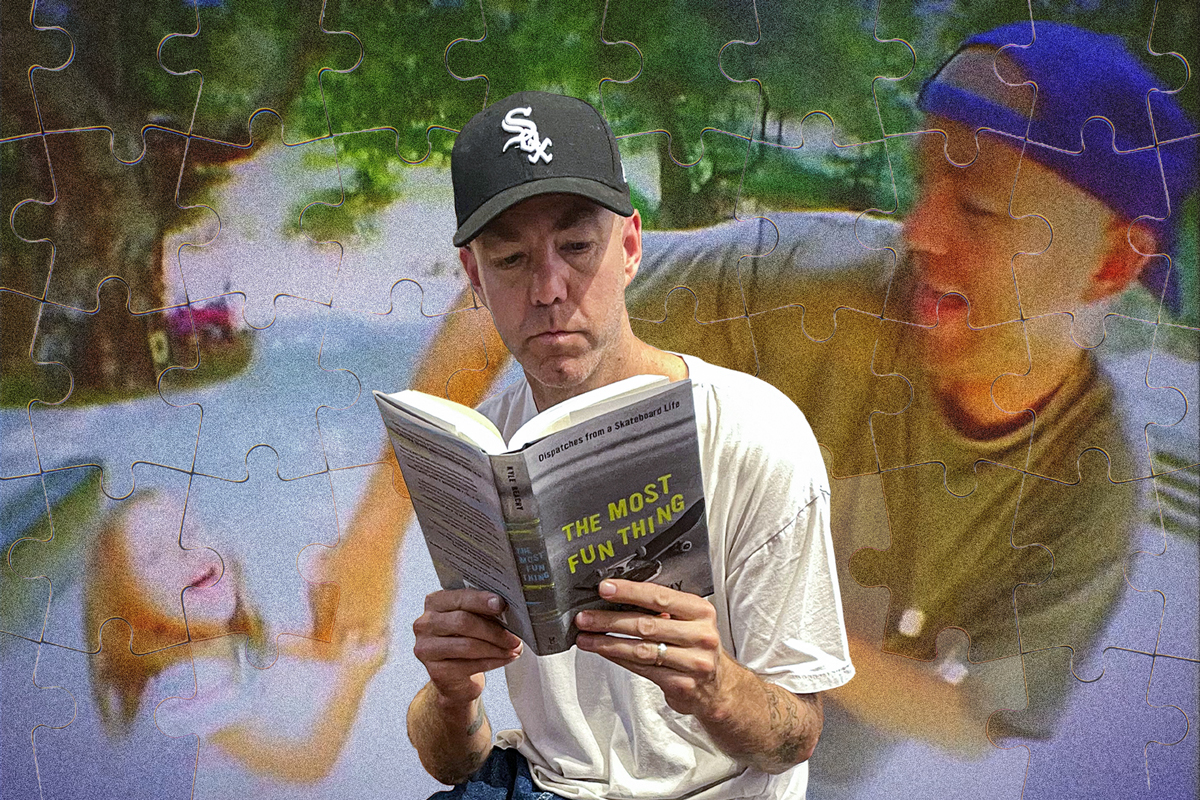
Portrait of Andrew Reynolds by Ryan Lay; still of Andrew and Stella Reynolds from Emerica’s Stay Gold by Jon Miner and Mike Manzoori
Collage by Farran Golding
In the midst of struggling to pen a novel about skateboarding, Kyle Beachy decided to instead simply write about a person he admired: Andrew Reynolds.
From the acknowledgement than no-one would argue the frontside flip belongs to anyone but Reynolds — an uncanny ability to unify skateboarding opinion — Beachy began to have more profound considerations of Reynolds. “The Boss became “The Boss” because at some point he stopped being the guy you were worried about and he started being the guy who people were guided by. He was a north star for all of these other skaters,” he says.

Kyle Beachy by Michael Worful
In the wake of Emerica’s Stay Gold (2010), Beachy also saw in Reynolds as as perfect a model of adulthood a skateboarder could achieve. Adulthood being “A crisis that you also, if you persist long enough at this most fun thing, will have to confront,” as Beachy writes in his essay, ‘A Very Large Puzzle: On Andrew Reynolds’.
The article, published by Jenkem Magazine, 2012 later became foundational text of Beachy’s second novel, The Most Fun Thing: Dispatches From A Skateboard Life. Published in 2020 by Grand Central, the book is a collection of writings on skateboarding spanning throughout the 2010s. In a new episode of our podcast, Beachy discusses writing that formative essay on Andrew Reynolds and who The Boss is to skateboarding today.
Listen to A Puzzle of Andrew Reynolds with Kyle Beachy on Soundcloud | Apple Podcasts | Spotify | YouTube
You can find show notes for everything related to the conversation below. We’ve also included a transcript of the Q&A conversation which has been edited for length and clarity.
Timestamps and Shownotes
00:00 — Introduction to the episode and Kyle Beachy
— “Reynolds eats fruits” — Forrest Edwards from Slap’s ‘One In A Million’ (2010)
— Emerica: Stay Gold (2010)
— ‘A Very Large Puzzle: On Andrew Reynolds’ by Kyle Beachy • Jenkem Magazine (2012)
— “Om Nashi Me” by Edward Sharpe and The Magnetic Zeros from the album Up From Below (2009), the soundtrack to Andrew Reynolds’ part in Stay Gold
1:27 — Kyle’s history with Andrew Reynolds
— “Undenied” by Portishead (1997), from the soundtrack to Reynolds’ part in The End by Birdhouse (1998)
— “Organ Donor” by DJ Shadow (1996), from the soundtrack to Reynolds’ part in The End
— Birdhouse: The End (1998)
2:10 — Kyle’s studies, journalism, career and first novel
— The Slide by Kyle Beachy (2009)
3:20 — Kyle’s second novel and early skate articles
— ‘You’re Not Me: Nyjah Huston and Inflationary Spectacle’ by Kyle Beachy • The Classical (2011)
— ‘A Chronicle of Doing It: Nike and Destruction’ by Kyle Beachy for Deadspin (originally published in The Classical, 2012)
— ‘The Deep Seams’ chapter on David Foster Wallace, featuring Dave Carnie, from The Most Fun Thing
— Kyle’s review of The Pale King by David Foster Wallace for STL Mag, 2011)
3:50 — ‘A Very Large Puzzle: On Andrew Reynolds’
— The Most Fun Thing by Kyle Beachy (2020)
5:00 — Interlude
— Stella Reynolds via Patrick O’Dell’s Epicly Later’d on Andrew Reynolds • Vice, 2022
5:15 — Sports Writing vs Skate Writing
— “Play-by-play” (writing style)
— “Colour” (writing style)
— Baseball Hall of Fame: Ozzie Smith
— Ozzie Smith doing a backflip
6:45 — Reynolds of the 2010s
— Rick Howard • Bobshirt, 2023
— Epicly Later’d: Eric Dressen • Vice, 2013
— Bones Brigade: An Autobiography by Stacy Peralta, 2021
7:26 — Kyle’s History with Emerica
— Emerica: This Is Skateboarding (2003)
— Kevin “Spanky” Long in This Is Skateboarding
— Bryan Herman in This Is Skateboarding
— City Stars: Street Cinema (2001)
— “Close To Me” by The Cure (1985), the soundtrack to Spanky’s part in This Is Skateboarding
— ‘The Making of This Is Skateboarding with Jon Miner’ by Dobija-Nootens • Jenkem, 2018
8:15 — Stay Gold
— Emerica: Stay Gold (2010)
— “Sleepy Silver Door” by Dead Meadow (2006), the soundtrack to Stay Gold’s intro
— Andrew Reynolds in Stay Gold
9:08 — Being moved by skateboarding
— ‘Sober Skaters’ panel at Slow Impact 2024
— ‘Over It: Skaters, Drugs and Alchohol’ • Thrasher Magazine, 2019
9:47 — Skateboarding journalism in the early 2010s
11:12 — Writing the Reynolds essay
— The Stay Gold B-Sides: Andrew Reynolds (2011)
— ‘The Rules of Skateboarding #20: Andrew Reynolds’ (on signature tricks and frontside kick flips) by Ian Browning • Village Psychic, 2022
— Kyle’s articles for Jenkem (2012 – 2017)
12:36 — Age and thoughtfulness
— Reynolds’ role in the lives of others (via Epicly Later’d, 2022)
— Reynolds’ past and sobriety (via Epicly Later’d, 2022)
— ‘Hijinx with J Strickland’ (“Baker/Bootleg era”) by James Lee • Jenkem, 2012
— Andrew Reynolds frontside flips the Love Park fountain gap in a leather jacket
14:55 — Heath Kirchart
— “Atmosphere” by Joy Division, the soundtrack to Heath Kirchart’s hidden part in Stay Gold
— “Going out with your friend on a motorcycle…” — Heath Kirchart in in Alien Workshop’s Mind Field (2009) and Stay Gold
— Vans: Propeller (2015)
17:05 — The Most Fun Thing
— ‘The Most Fun Thing: An Interview with Kyle Beachy’ by Will Harmon and Nick Sharratt • Free Skate Mag, 2021
— ‘Followed: Ryan Lay’ • Pocket Skate Mag, 2023
20:37 — Rooting for Reynolds
— “Toujours Vivant” by Gerry Boulet (1988), the soundtrack to Andrew Reynolds and Jake Johnson’s shared part in Dime’s GLORY: The Legend of Dime (2024)
— ‘New Balance Numeric | Andrew Reynolds’ (2022)
— ‘Andrew Reynolds Brings New Balance Innovation to Numeric with His Tech-Heavy 933’ by Josh Sabini • Sneaker Freaker, 2025
22:21 — Revisiting Reynolds
— ‘The Best Skate Video Parts of the 2010s — QS Reader Survey Results’ • Quartersnacks, 2019
— ‘Reading List: A Consensus By and For The Crowd — The Quartersnacks Readers Poll’ • Skate Bylines, 2024
— “Kosta” — Konstantin Satchek, founder and editor-in-chief of Quartersnacks
24:43 — The wholesomeness of Baker Has A Deathwish Part 2
— Baker 4 (2019)
— ‘Where Do We Go From Here? Watching Baker 4‘ by Mike Munzenrider • Village Psychic, 2019
— Baker Has A Deathwish Part 2 (2024)
— “Strangers” by The Kinks (1970) from Andrew Reynolds’ part in Baker Has A Deathwish Part 2
— ‘Is skateboarding really a subculture anymore?’ by Kyle Beachy • Huck Magazine, 2024
— “Mandy” by Barry Manilow (1974) from Stu Kirst’s part in Baker Has A Deathwish Part 2
— Baker Has A Deathwish (2008)
26:02 — Baker Has A Deathwish screening fundraiser
— Anthony Pappalardo (“The Writer)
— Espanola fundraiser recap via Erik Ellington
— Fundraiser recap via Anthony Pappalardo
— Baker and Deathwish fundraising boards
— “Getting fucked up tonight!” — Erik Ellington in Baker 3 (2005)
29:09 — Outro
— ‘A Very Large Puzzle: On Andrew Reynolds’ by Kyle Beachy • Jenkem Magazine, 2012
— The Most Fun Thing by Kyle Beachy (2020)
Transcript
A Puzzle of Andrew Reynolds with Kyle Beachy, author of ‘The Most Fun Thing’
Farran Golding: When you were at college you were writing about sports. What differences or similarities are there in the way that sports writing deifies athletes compared to the way that skateboarders deify professional skateboarders?
Kyle Beachy: The sports that I covered were high school athletics in the Inland Empire of Los Angeles, California so there was not a lot of deification that was going on there. I was going to basketball gymnasiums in Rancho, Cucamonga, watching a game on a Friday night and doing the play-by-play with a little bit of colour.
That said, I grew up with like my hero being a certain baseball player named Ozzie Smith who was the best defensive shortstop to ever play the game. His nickname was “The Wizard” so there was this mythology around him, right? He would very famously, on his way out to his position, do a backflip occasionally. It was the most stylised element of baseball that maybe I can recall, he was a stylised player, so I always had an interest in flavour, I guess.
But I think your question is more about, like, how does writing about sports translate to writing about skateboarders or skateboard figures? I don’t really think it does. The role that skaters have played in my life has been so fundamentally different than anything that an athlete has played because my understanding of skateboarders has always been as people whereas athletes were always these numbered uniforms on a field.
At the point where you start writing this essay on Reynolds, who is Andrew Reynolds to skateboarding at that point in time, do you think?
I think for the industry what’s Reynolds was, at the time, he was an adult. It was him, it was Rick Howard, these were the guys who were still in the industry and still playing an active role in the industry, in ways that people before them really hadn’t before. We can point to like Eric Dressen, we can point to the vert guys, we can point to the fact that we’ll never stop hearing about the fuckin’ Bones Brigade but here are guys who organically came out of a street [skating] ethos, stayed in the industry and they took leadership roles.
Your essay follows this culminate moment with Reynolds that comes with Stay Gold. What do you remember feeling seeing Stay Gold for the first time?
I remember This Is Skateboarding less because of Reynolds and more because of Spanky [Kevin Long] and [Bryan] Herman. City Stars wasn’t a thing I was super privy too so when I saw Spanky I was like, “What is this? The Cure? This kid? This is great!” My exposure to Emerica was largely about admiring Jon Miner, admiring a skate video maker who had his own aesthetic. It became kind of funny all the green stuff but Miner committed to an aesthetic and ran with it. This is all to say that when I sat down to watch Stay Gold, I was ready for anything. I was not coming at it as a fanboy for such an for such an established company, I came in pretty open to it. I remember by the end, by that closing section, it was one of those times where you feel emotional. I felt moved by skateboarding. I felt like, “I’ve not wasted my life.” Put this in the column of arguments for why you have not wasted thirty years of your life doing this thing. That’s something I think a lot of us, especially as we age, start feeling less and less and when it does happen you feel this immense gratitude. Maybe that’s the other thing to add to the Reynolds thing: I felt gratitude by the time I started writing that. I wanted to be like, “Thank you for this. What have you done?”
What are some other times you’ve been moved by skateboarding in that way?
Oh, I’m moved by skateboarding constantly now. I go to Slow Impact, I look around the room and I think: “I cannot believe all of these skaters are in Tempe, Arizona.” Here’s this panel talking about addiction which is a conversation I’ve heard 50 times in the context of skateboarding but this time it’s done newly and I am like so moved by it.” I’m pretty regularly moved. I weep because of skateboarding fairly regularly.
I want to speak to you about this essay and Reynolds because it always stuck with me. It was one of the early things I read, when I was first starting writing about skateboarding around 2012 to 2013.. What did you think about the quality of the written word that existed in skateboarding media at that point?
That’s a really hard to answer question because what I was doing required me to have a sort of chip on my shoulder. I had to I had to be like, “I’m going to chart this new territory.” Looking back, I realise of course I wasn’t. Every era of skateboard history has had writers who are doing interesting, compelling and often challenging writing. It’s just that writing hasn’t tended to live as long as the photographs or the video. I had just interviewed [Dave] Carnie, he stood out to me, but I didn’t want to do what Carney was doing at all. We were doing very different things. I knew of and had read Boil The Ocean, that to me seemed like the sort of thing I had to stop reading because I needed to I needed to be independent of it.
I’m speaking of this as a thing I’ve grown out but, at the time, I had to believe that I was doing something new and that I was, like, the underdog. To that end, going to Jenkem and being very forthwith and saying, “I’m going to write you something about Reynolds. My guess is I came out swinging pretty hard, like, “Hear ye, hear ye, check me out. This is going to be sick.” I think I needed to believe that I was doing something new.
What’s the earliest thing you can remember putting pen to paper for it that was like, “Okay, this is going somewhere.”
It was what ended up being the opening which was about arguments. Like, “Here is a guy who seems somehow to transcend the basic currency of skateboard conversation which is arguing. Which is taste. I don’t know anyone who would say that the frontside flips — still — isn’t Andrew Reynolds’ trick. We could have said the impossible was always Ed Templeton’s but then Dylan Rieder came along. The fact is is that Reynolds’ frontside flip is beyond the scope of typical skateboarding like currency. It somehow escapes the standard back and forth, tit for tat, irreconcilable differences that all skaters have about style and taste. So it started there. It started with, “Hey, we’re assholes and yet here’s one thing we agree with.” Basically, everything I wrote for Jenkem, when I look back now, was trying to show skaters they were more thoughtful than they are. It was basically trying to say like, “Here’s this thing we do that means we’re not pieces of shit.
Age and thoughtfulness are the two main themes of the story. How did those ideas around him and those notions come together?
Well, I think the other thing the other factor we have to bring in is as much as I was agog at how it seemed successfully Reynolds had become an adult as a model… You know, he and I are roughly the same age so part of it is like, “Thank God, I can keep doing this.” Here’s someone who has gotten through things and seems like less of a piece of shit than ever” and not doing it by stepping away from skateboarding, but actually doing it through skateboarding.
I think it’s a combination of what came through and Miner has a lot to do with that. The way that part was edited, the opening 16mm footage of him in the backyard with Stella. Part of it is what we saw and part of it is what we knew from before it. This is where that sort of narrative thread comes into it. He’s obviously was not in the same place he was in five years earlier, he’s obviously not in the place he was in ten years earlier. Part of it is just the basic reality of the human compulsion toward narrative which is understanding how characters change.
We knew he was sober, sobriety had a lot to do with. I think I get it this in the article, he seemed to have like paired his wardrobe down to one green shirt that said “Florida” across it and like standard fitting jeans. So part of it was also what we knew about behaviour but then also fashion, this sort of like stripping away of all the “extras” of the Baker/Bootleg era of leather and buckles and all of this stuff I couldn’t imagine ever skateboarding in. Suddenly, now he’s focused in a different way.
Maybe this is another part of it: he’s looked good in every era. He has looked good in every particular kit that he has put together. Maybe that’s it, maybe it’s familiarity. That’s basically what it comes down to. You look at these people for so many years that they either end up disappointing you in some way or you’re pleasantly surprised to not be disappointed.
I came up with this joke with a friend about how Heath Kirchart is like the shadow version of Reynolds. Heath keeps to himself, Reynolds is public facing and he’s a beloved pro. Not that Heath isn’t beloved but it’s in a different way. Reynolds has the deservedly grandiose last part in Stay Gold and Heath’s part is tucked away as an extra.
Also, the combination of two different kinds of fortitude, right? The fact that Heath continues to linger as this spectre in the industry, he’s producing Epicly Later’d with Patrick O’Dell but he has no reason to remain in skateboarding despite the fact that Heath’s a skater. I have no idea if he watches if he watches clips, if stays up on skateboarding, my guess is he doesn’t at all. But the fact is he can’t quite get all the way out of it. I think there is a sort of neat inversion of Reynolds there where Reynolds’ version is to be skating all the time, no matter what. Heath is sort of just like, “Well, I can’t quit you.”
Ryan Lay has this whole notion that we’ve lost stunt stair guys. We don’t really have anyone who’s like, “I’m going out at midnight with my friend on a motorcycle and that’s that’s how I’m going to get my clips.” That doesn’t really exist anymore that sort lone gunman theory of being completely out there doing your own thing. Reynolds is the one I want to be friends with. Heath was at the world premiere of Propeller when they were doing screenings on a world tour, at the back of a theatre in Chicago where I watched Propeller for the first time and he was tucked away in the back corner, his feet up, his hat down but it was obviously that you’re Heath Kirchart. But I didn’t want to go say “hi” to him. There’s a there’s a well cultivated standoffishness that I respect but also like feels, to me, very anti-skating or what skating is now.
You write about navigating into adulthood as “A crisis that you also, if you persist long enough at this most fun thing, will have to confront.” Beyond the title of your book stemming from that phrase, how did the Reynolds essay inform your book, The Most Fun Thing?
The Reynolds essay is a load bearing column for what became the book. The fact of the book is that after a writing nearly a decade of these these articles for various places at a certain point it was like, “I have enough of these. Let’s see if they could become a book.” Even prior to that, I saw my project always as a continuous thing. One of the things that made me very bad at writing about skateboarding was that I was never willing to repeat something I had said in another article. I saw each individual article as like the next step from the last one I wrote.
I think the challenge always for me, or the reason really I started writing about skateboarding was that I didn’t understand why I kept doing it. Then I have this other thing, that I profess to be my calling and my passion which is writing, which I have to work so hard to get myself to do. So how is it that these two things are so important to me in two totally different ways? One of them happens effortlessly despite the fact that it hurts me, despite the fact that I have a bad knee, I have a bad foot, I have a bad shoulder right now all on the left side because I’m regular footed and that side of your body when you do it long enough is the one that gets fucked up. My front foot, my front knee, and my front shoulder are wrecked. I’ve never been a stair guy, this is just accumulated damage. So how is it, even given that, I keep going skating all the time?
Then there’s this other thing that rewards me financially, that actually is the basis for the twenty year career I had as a college professor, that I feel more accomplished doing after I do it than skateboarding even. When I write something good, I feel better than I do after I land a trick, for sure. Why is this writing thing so hard to get myself to do? So trying to reconcile those two radically different, equally important but in totally different ways, one of them the best thing in the world — skateboarding — the other sometimes the worst, how is it that these two things are so important at the same time?
I’m better now at dealing with the ways that writing is hard, I’m easier on myself. I allow myself to sit down for four hours and walk away with two sentences and not think, like, “What have you done? Go do something else with your life.” I don’t know if it’s that people who commit serious parts of their lives to writing are harder on themselves than other people but I do know that what writing affords is endless opportunities to really be hard on yourself. Which I should say, I am not hard on myself with my skating. There are people like Ryan Lay, my good friend, my dear friend. I’ve watched him land the same trick six times and still not be happy with it. I am so stoked if I can scrape out the ugliest facsimile of a make. Toe drag, weird hands, stutter, yelling afterwards, looking not good, dressed poorly. I’m fine with the clip because I have this whole other realm of my life where all I do is be hypercritical and meticulous about what a sentence needs to be. Skateboarding is this outlet where I’m just like, “Fuck, I can’t believe I landed that!”
The Stay Gold part really makes you root for Reynolds. I enjoyed that lower impact footage in Stay Gold probably the most of all of it. When you watch his footage now it’s like, “You’ve earned that. You’ve earned filming ledge lines and doing manuals.”
There’s something about his particular skillset in this particular era of his career that is leading to, again, a simmering level of appreciation. When you’re not just, like, “I’m stoked to see a Reynolds trick” but when you get to the point where it’s, like, “I don’t like that trick, generally, but I like this one.” So the follow up essay would be like, “Why?” What is it? Am I just giving him a total pass? Am I so biased? Am I completely without critical ability? Does he render me somehow useless as a critical skate consumer? Has he transcended criticism? Or has he negatively affected my eye.
I don’t know. But I would say there is a case to be made for for the combination of daddy-ness and I mean that in terms of grey New Balance, pulled up socks; the guy is mowing the fucking lawn all across L.A. and there’s something unimpeachably good about it. It feels good. To have something like that, you want to look at it hard and you want to consider where that goodness comes from. But at a certain point you also just want to step back in and kind of appreciate it.
At the end of 2019, Quartersnacks ran their first ‘Readers Poll’ which was a recap on the decade’s most influential videos and video parts as voted on by Quartersnacks readers. You wrote about Reynolds in Stay Gold. How was it revisiting him in that video all the years down the line from the ‘A Very Large Puzzle’ essay?
It was wonderful. First of all there’s something about being solicited to write those sort of things. This is where I feel FOMO as a writer but every year I’m like, “Damn!”
When you’re given 150 words, I love working with in that sort of format. I love trying to cram what is a probably a 3000 word essay into 150 words. That’s a fun challenge. You want to give it its due and it’s very hard to do that without just listing the cool things about it. You want to say something. That’s what readers come to those for and what Kosta [Konstantin Satchek, QS founder and editor-in-chief] gets the assortment of writers for that he brings in. It’s like, “Here are people I can trust to say a thing, to believe a thing about this.” It’s a wonderful format. I’m so stoked on them every year.
It felt, in a selfish ego way, really nice to be connected to Reynolds in that way. As the writer, you want to write about as many different things as you can especially about skateboarding. You want to have as many different inroads into skateboarding as you can find, or at least I did. That’s what an essay is: “Here is this thing, I’m going to try find all this ways into it.” Essentially, by writing about different parts of skateboarding you’re just finding your way into skateboarding and different angles. That said, it was nice to be able to return to Reynolds having already said enough about Reynolds that I felt like I said enough and have the chance to kind of — this is going to sound very strange — but treat Reynolds in a way as mine. Like, “Ah yes, I’m back here again.” It was a very unique writing experience to do that little thing and was super hyped to do it.
Kosta will be a due a text from me in, like, three weeks saying, “Can I write about this part for the end of year thing.”
I think what you just said is also a really important lesson for anybody who happens to hear this. What what you just said is a really necessary thing to do in the world of skateboarding and the world probably more generally which is if you want to do a thing you should reach out and ask. If you want to do a thing you should put yourself the mix by asking to do the thing. So, yeah, thank you for that reminder.
You mentioned prior to this conversation that you’d rewatched Baker Has a Deathwish Part 2 in theatre where you live. Could you tell me about why that was going on?
Isn’t it strange that we didn’t we didn’t know that Reynolds edited the Baker videos until, like, Baker 4. Am I right about that? I certainly didn’t know that he was actually sitting down at the desktop forever doing all the editorial work, picking the music, making the video. But I think everyone came to Baker Has A Deathwish Part 2 knowing that, knowing it was him. It’s very hard not to watch Baker Has A Deathwish Part 2 and not notice how wholesome it is. I just wrote an op-ed for Huck Magazine about skateboarding, if you can believe it. One of the things I point out, if you if you look at 29 minutes into Baker Has A Deathwish the first you have Dustin Dollin with no pants on, kicking beer bottles, to “I am the god of hellfire!” At 29 minutes into Baker Has A Deathwish Part 2 you have Stu Kirst hugging Rowan Zorilla while “Mandy” is playing so it’s a very different experience. I mean, his fingerprints all over it. You feel it, you feel middle-aged dad Reynolds throughout.
But yeah, to your question, so the circumstance of the screening here. At a local theatre, organised by the writer Anthony Pappalardo, who was very nervous that not a lot of people would show up. Turns out there were probably about 150, 200 people for this screening which was the sort of culminating event for a fundraising event for a local skate park here in the town of Española, New Mexico. You know how skateparks are, there are shitty ones. The one there is sparse, there’s not a lot of options, and it is a real sort of geographical hub for a lot of kids who live on the reservation, for a lot of kids who are under-resourced in economically scarce areas and so on. So it would be a really wonderful thing to have a proper park there.
There was a dual deck release, [Erik] Ellington and [Sammy] Baca were out. I managed to meet them both without making an ass of myself. I got to hug Sammy Baca twice and I will say he has an exceptional embrace. The most moving thing about this, beyond the fact that there was this great turnout, beyond the fact that they sold out of at least one of the boards, besides the fact that Ellington was there and he’s an exceptional ambassador to skateboarding and Baca is the most spiritually uplifting person you can ever meet. Prior to the actual screening, the screening was delayed so that we could have three distinct dances by indigenous dancers. They were in full Native American regalia bringing an energy to this skate event that has, at once, nothing to do with skateboarding and at the same time as you’re watching it you realise, absolutely, this is skateboarding. To put on to put on this regalia that speaks to not only who are but the lineage of people that you’ve come from. All of the beliefs of those people, all of the rituals, to stand up there and spin and step with this pace. Swinging your legs, arms, hands and held objects, it was impossible to separate it from skateboarding. This too is the spiritual element that has given birth to this weird, stupid fucking thing that we do.
I leaned over to Anthony and I was like, “Oh shit, dude. I think skateboarding got a little bigger.” It was an event that everyone there knew was special. You know that skateboarding events can feel either completely contrived and ludicrous or it feels, like, “Oh my God, this is the most magical place I’ve ever been.” There was a combination of factors that led to feeling, like, “Holy cow, this is this is. This is why we do it.” There was not a single native native kid who did not get a photo with Ellington. He was incredible, he was present, he was kind, he was generous, it was beautiful. It was, like, “Holy shit, I cannot believe this is the same guy who is going to “get fucked up tonight” after a bigspin.” Skateboarding gets better the more of this that we have.
I think you’ve naturally come to reiterate in the final line of your Reynolds essay quite well. Could you give us that?
Yeah, I will repeat it because this requires repeating: “Skateboarding is going to be okay.”
By the way, I really am honoured. It’s very special to be asked to revisit a thing that you’ve written. Things disappear. So I really do feel quite honoured.
Farran Golding is the founding editor of Skate Bylines, a senior correspondent for Quartersnacks and the associate editor at Closer Skateboarding. His writing on skateboarding has also been published in GQ, GQ Sports and Huck.
Kyle Beachy is a skateboarder, educator and author who lives in New Mexico, USA. His two books The Slide and The Most Fun Thing: Dispatches From A Skateboard Life can be found, hopefully, wherever books are sold.
More from ‘The Most Fun Thing’
“Suppose Hunt managed to make a movie that conveyed Dylan Rieder as he was. Suppose that, by knowing his friend so well, and going out shooting with him and editing that footage and presenting it as he did, [Greg] Hunt achieved that most impossible thing—gave us a way of knowing another person without ever meeting him.” — Kyle Beachy skateboarding, style and Dylan Rieder.
Considerate conversations
“It’s an accessible first point of, like, ‘How do I connect with this culture?’” — Ian Browning examines municiple space in New York City through the lens of the Lower East Side Skatepark in ‘The Civic Center of New York City Skateboarding’.
“It’s that, married with physical talent, which makes a good skateboarder. But I do think it’s the personality bit that’s more crucial. And that’s where the interview comes in. It explores that very thing.” — Question and answer interviews have long been a predominant format for written skateboarding journalism. To unpack how they became so ubiquitous and decipher what, exactly, makes for a good one, the script was flipped on Eric Swisher (“Chops”) of The Chrome Ball Incident.
