
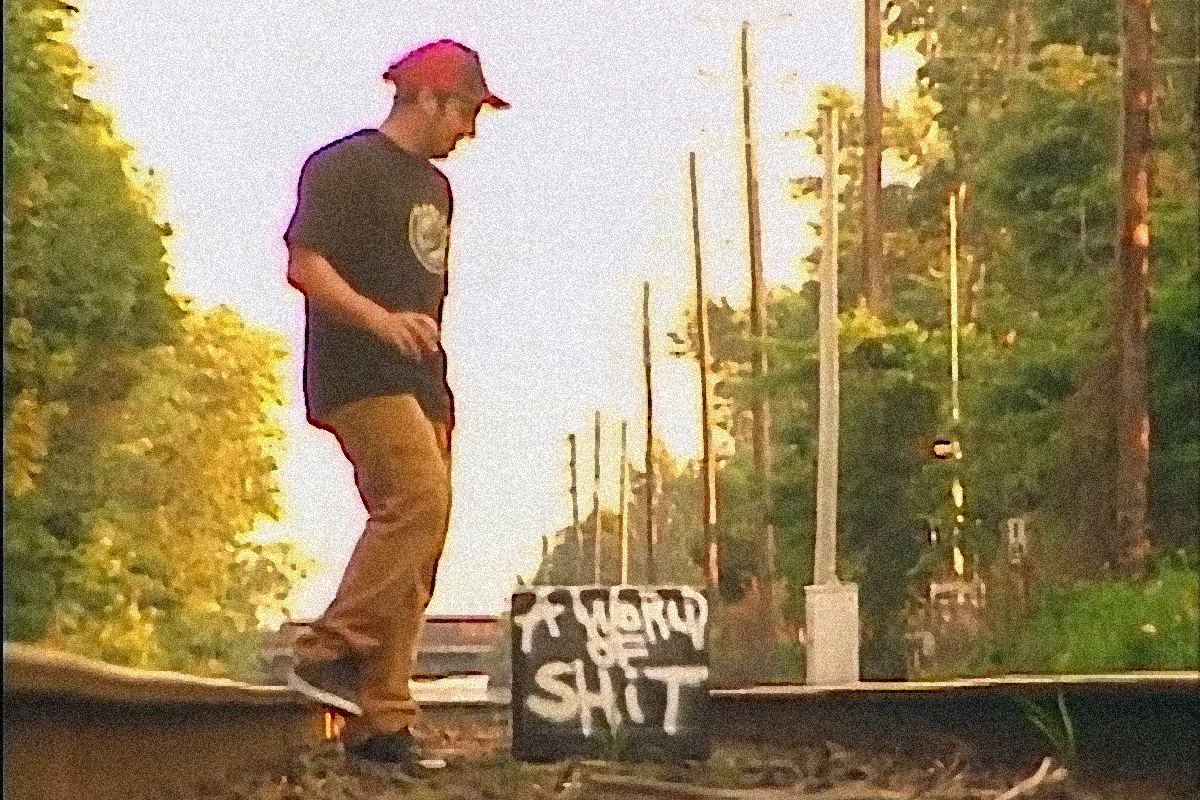
Fred Gall is known for skating rugged spots many have to be made feasible in the first place. What lengths would you go to in order to make a spot skate-able?
This story is part of ‘New Year, New Rules’, which welcomes columnist Ian Browning and his ‘Rules of Skateboarding’ series of interviews to Skate Bylines.
Interview by Ian Browning
Headline still: Inhabitants by Habitat Skateboards (2007)
You’ve had a fair amount of footage on crusty banks and ditches over the years, and they’re often spots I haven’t seen other people skating. What’s the most effort you’ve had to put into skating a spot?
I’ve put serious time into spots. From fixing them to finding them. Recently, I’ve been skating this full pipe that I had to do extensive work on to even skate. Patching holes and fixing cracks and shit. Just finding the spot took me a while because I had to track it down and get the dudes to give up the info.
Is that one indoors?
Yeah, it’s indoors. I can’t give the town or location though.
Is it some sort of industrial building you had to sneak into?
Yeah, it’s like an old airplane hanger, I think. I don’t know what they used to do there but it’s a fucking serious full pipe and it’s pretty fucking rad.


Other forms of pipes which Fred Gall has plumbed over the years.
Habitat Skateboards; photography by Mike Blabac (left) and Ryan Gee (right); design by Joe Castrucci
What do you think about modifying a spot to make it skateable? Do you have a line you draw where it starts to make the spot not count?
I mean, you can’t go too far with it. You don’t want to make it perfect, you know? But fixing a spot, modifying a spot is all right. As long as you don’t go too far with it.
I remember in Fully Flared they were skating a handrail that they had put into the ground.
Yeah, that’s what I mean by going too far with it. As long as you don’t make it too fake. If you find the handrail at the spot and put it in, that’s all right, but I think bringing your own specifically made shit to the spot kind of takes away from it.
I’ve found a handrail at a spot and I rigged it up there, and I think that’s better than actually making the rail for the spot and bringing it there.
Fred Gall in his natural habitat. Bondo, rub bricks and wax all essential. Habitat Skateboards: Inhabitants directed by Joe Castrucci and Brennan Conroy (2007)
What about wax? Do you use a lot of it?
Yeah, you need wax for sure. There’s wax and then there’s the brick. You ever see one of those?
Yeah. The rub brick?
The rubbing brick. And then if you want to get real crazy with it and the thing doesn’t grind at all, you could just skim coat it with Bondo and then that’ll make it grind.
That’s tight, I didn’t know that. You do the Bondo and then wax over it?
Yeah, you just skim coat light Bondo and it’ll make anything grind pretty much.
From rub bricks to red bricks. Habitat Skateboards: Inhabitants directed by Joe Castrucci and Brennan Conroy (2007)
“You find something and it might not be anything, but you can create something out of it just by adding some concrete.”
So you said you put a lot of work into finding spots. How do you do that? Do you just drive around?
Yeah, it’s basically a mixture of luck and knowing what areas to look in. Industrial areas are good. Anything abandoned. You know, you find something and it might not be anything, but you can create something out of it just by adding some concrete.
For sure. Is there anywhere that sticks out where you’ve gone on a mission and you’ve tripped out on where you ended up?
I mean, there’s this one street by my house, Industrial Ave. That street alone, over the years, spots just keep coming. There is nothing there at all to skate. It’s just a fucking road with some industrial buildings and shit but over the years shit just keeps popping up there.
They built some banks at one point, just a loading dock bank and there was a street post, like a hollow metal black telephone pole lying on the ground. It was a typical bank to rail where you couldn’t really skate the rail because it was too high. I duct taped it with black duct tape on the middle of the rail so it made it waist high and it made a perfect bank to rail. You couldn’t even tell it was made to skate. It just looked like it was meant to be there.
At one point there was a square metal structure there. I don’t even know what it was for, but I could tell the inside was round. You could see a shape of roundness. So I climbed in it and it ended up being a full pipe on the inside with holes that you could do rock to fakie on. So that’s just and an example of how spots pop up there.

As Fred Gall as it gets
At that same spot they were doing construction and they had those gigantic land mover dump trucks that have a full bank in the back.I had a photo doing a noseblunt grab into the bank in the back.
I built some concrete there a couple times. There was a little slanted wall so we added a some concrete and made a little quarterpipe. Up the hill we covered some grass with concrete and made a bump over this gap. It’s all on the same street in a one block radius.

Fred Gall wallrides a bus in Bangkok, Thailand, published alongside its backstory in The Skateboard Mag, October 2011 Words and photography by Matt Price
Where is the craziest place you’ve ever skated?
I guess one of the craziest spots ever is the abandoned area in Cincinnati called Glencoe. Cincinnati is very hilly—most of the city is on the hill. At Glencoe, you can go back into these alleys there and it was three blocks of hills with buildings on each hill. Like, three separate buildings on three separate blocks that were just fully abandoned. It looked like a fucking warzone. And there’s banks on each different building.
It was real sick, but it was creepy as fuck. You’d be skating and like see a head peep out from one of the buildings on the hill and you didn’t know if they were going to come rob you or what the fuck they were doing in there. Smoking crack or doing whatever. Definitely sketchy, and definitely a scary spot to be at night.
I found a gun at that spot actually.
What?
Yeah, we were skating this ledge and I had a camera, so I went across the street and I walked up the parking lot to the next level. I was on the corner of the building and I stood on this planter to so I could get a good angle over the edge of the building. I looked down and there was a 9mm [handgun] inside of a flower pot, just stashed. We called the cops and told them there was a gun there and then just left. We didn’t want to deal with it. We reported it so no one gets fucking shot.
Ian Browning is a journalist and essayist based in New York who writes about the intersection of skateboarding and culture. He has written for Quartersnacks, Simple Magic, PLANK, Closer Skateboarding, Jenkem and Eater. As a columnist for Skate Bylines his ‘Rules of Skateboarding’ series explores nuances with notable characters.
More from the author
“It’s an accessible first point of, like, ‘How do I connect with this culture?’” — Ian Browning examines municipal space in New York City through the lens of his Quatersnacks story on the Lower East Side Skatepark in ‘The Civic Center of New York City Skateboarding’.
“Why does this story matter? Why is it relevant to the current moment and that publication? Why are you the person to tell it?” — Cole Nowicki, Ian Browning, Josh Sabini, Claire Alleaume, Norma Ibarra, Greg Navarro and Alex White share insights on pitching stories to skate magazines ans brands from a variety of creative perspectives and backgrounds in ‘Making The Big Leagues’.
“One of the main ideas that led to this series was wanting to be able to bring the type of debate that happens during a slow shift at a skate shop, or on the periphery of a wound-down session, where skate nerds air out their strong opinions.” — Ian Browning discusses the origin of ‘The Rules of Skateboarding’ and his highlights from the series.
This story was originally published by Village Psychic on December 4th 2017 under the ‘The Rules of Skateboarding #4: Fred Gall’. Browning joined Skate Bylines in 2026, bringing over his previous columns and continuing his ‘Rules of Skateboarding’ series.