
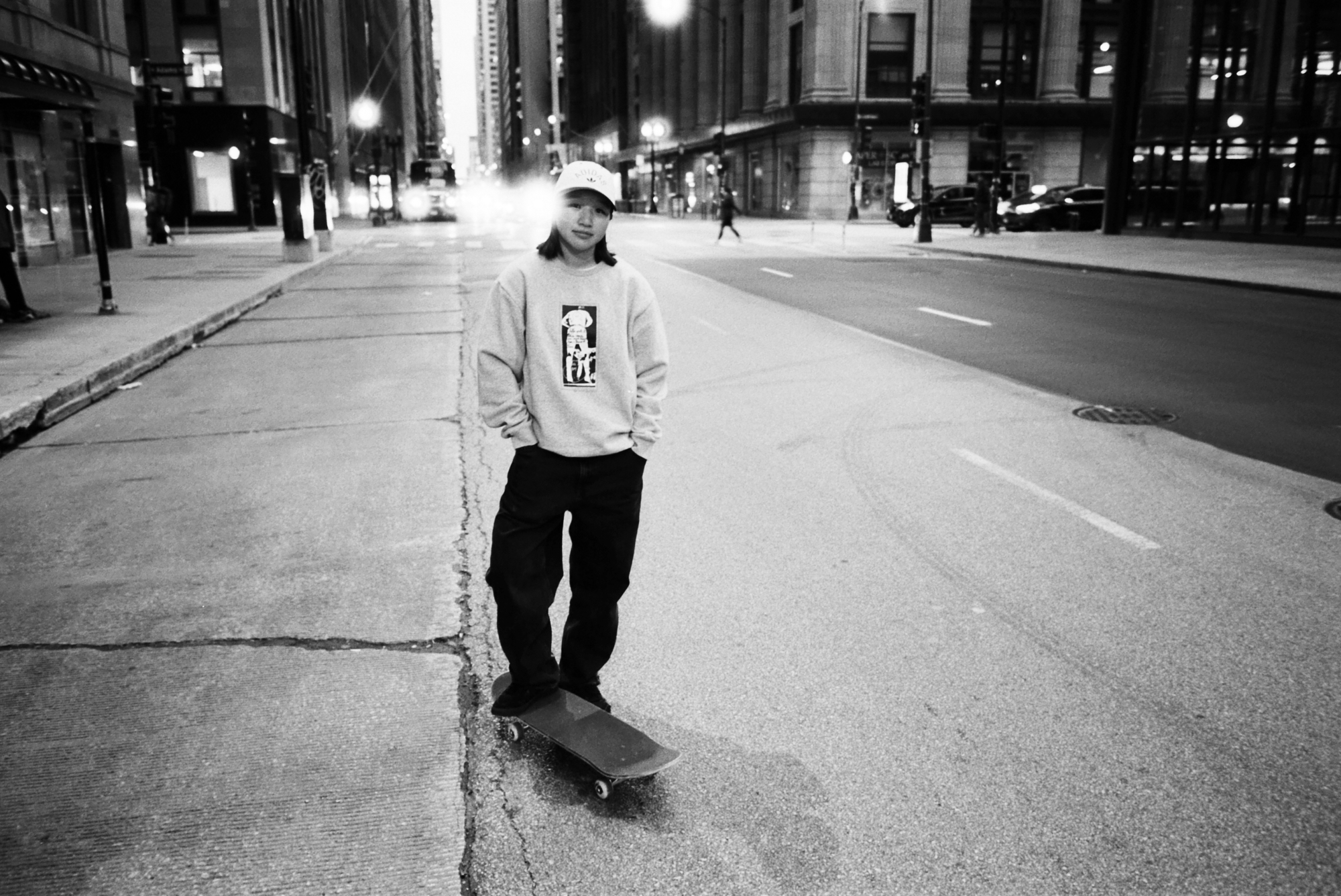
Momiji Nishiya’s debut video part for adidas Skateboarding showed there’s more than medals awaiting the generation of skateboarders who rose to prominence from the Olympic podium. Natalie Porter writes about the precedent Momiji sets and what her competition contemporaries and skate culture at large can take from it.
Photography by Zander Taketomo
The support for Momiji Nishiya’s debut street video part, ‘MOMIJI’, across the worldwide skateboarding community is resounding. I could rhapsodise about the exacting way she reverts out of a trick or the crook nollie heel ender. Directed by Chris Mulhern for adidas Skateboarding, scored to a soundtrack featuring Japanese singer Yurika, anyone with a clue knows that Momiji’s effortless, floaty style is deceptive. It’s all there to witness and study on repeat. Instead, I want to focus on the deeper significance of this production: ‘MOMIJI’ is a win for all skateboarders because it reveals that we survived the Olympic doomsayer’s worst fears and Momiji’s resilience beyond the Olympic bubble is undoubtedly heroic.
“‘MOMIJI’ is a win for all skateboarders because it reveals that we survived the Olympic doomsayer’s worst fears” — Natalie Porter

Momiji Nishiya. Chris Mulhern
In no way am I downplaying Momiji’s accomplishment as the first female Olympic gold medalist; taking the top podium for “street” at Tokyo 2020 also positioned her as Japan’s youngest ever gold medallist. To perform at such a level in your home country during the intensity of the pandemic is awe-inspiring. Momiji killed it. Granted, she did not have the media’s attention compared to her countrywoman, the intensely shy park skater, Misugu Okamoto, who was expected to win gold with her massive 540s. The hype surrounding Misugu was evidently too much to bear. That iconic image of her being hoisted onto the shoulders of Poppy Starr Olsen and Bryce Wettstein after she bailed and was knocked off the podium is glorious. But sadly, Misugu has reportedly never skated again and Japanese filmmaker, Yuri Murai shared with me that this was due to her experience at the Olympics.
“One of my fears about the Olympics is related to how the mainstream media glorified these very young female skaters … I worried that the message to other girls would be that their sense of worth and validation is tied to Olympic glory, which only happens for an elite few every four years.” — Natalie Porter
One of my fears about the Olympics is related to how the mainstream media glorified these very young female skaters. Typically, the youngest female Olympians were gymnasts until the age of eligibility was set at 14 and then raised to 16 in 1997. Without an age limit in skateboarding, in Paris 2024 we saw Zheng Haohao, age 11 from China; Vareeraya Sukasem, age 12 from Thailand; Heili Sirviö, age 13 from Finland; and a throng of 14-year-olds who were all their country’s youngest athletes. While it’s fantastic that these teens (including Arisa Trew who became the first woman to land a 900 this past summer) are pushing the boundaries of skateboarding, I worried that the message to other girls would be that their sense of worth and validation is tied to Olympic glory, which only happens for an elite few every four years.

Momiji Nishya. Chris Mulhern
The fact that Momiji was unable to qualify for Team Japan in 2024 is staggering. The depth of talent coming out of Japan is relentless and wonderful, but what happens next? A few product placements and a gradual fade into oblivion? Hell no! Momiji channeled her disappointment (we know she was bummed) into this killer video part. Fuck yeah. Because, ultimately, contemporary skateboarders often recognise “legacy” through one’s audiovisual contribution to the culture at large and not what is inked onto a scoresheet.
Moving forward, I want to see more female coaches, commentators, judges, photographers, filmers, company owners, and a whole network of opportunities. As a community, let’s celebrate and support these young contest skaters but also remind them that there is hope when the Olympic industry has spit them out and moved on to “the next best thing” because that’s not how skateboarders operate. All hail Momiji, patron saint of former Olympic skateboarders.
Natalie Porter is the founder of Womxn Skate History, an online resource which catalogues and celebrates the visibility of female and non-binary skateboarders throughout history and into contemporary skate culture. Her thesis ‘Female Skaters and the Negotiation of Space and Identity’ (2003) was the first academic paper written from the perspective of women in skateboarding. Porter has presented at Slow Impact (2024), Stoke Sessions (2023) and is a subject expert for The Smithsonian Museum in anticipation of a traveling exhibit. Her book, Girl Gangs, Zines and Powerslides: a history of badass women skateboarders was published by ECW Press in 2025.
Thoughtful reading and long-reads
“Alexis Sablone speaks at the Guggenheim Museum a year after launching a signature shoe there … The days of university-educated skateboarders crowbarring former pro-skater Ocean Howell’s quote about skateboarders being Love Park’s “shock troops of gentrification” into their assignments are long gone. Now, a wealth of academic material exists around skateboarding.” — Brian Glenney delivers a primer on scholarly studies of skateboarding in ‘Wicked Smart’.
“Skaters learn and teach. But there’s more to it than tricks and camaraderie.” — Sander Hölsgens, co-founder of Pushing Borders, gives Brian Glenney’s skate studies a peer review and streamlines a digestible reading list of where to start.
“Suppose that, by knowing his friend so well, and going out shooting with him and editing that footage and presenting it as he did, Greg Hunt achieved that most impossible thing — he gave us a way of knowing another person without ever meeting him.” — In a heartfelt essay from The Most Fun Thing, Kyle Beachy considers style, soul and the legacy of Dylan Rieder.
“What’s so inspiring about watching Brad Cromer skate flatground alone, without a soundtrack? Why do I get hyped watching him water his lawn?” — Finn Anderson explores the solitary skateboarding and soundscapes of Miami in ‘Brad Cromer’s Lonesome Crowded Florida’
More stories about skateboarding media
“I have an interest in a specific peer group who would maybe think about their practices as self-reflexive, exploring theory through production methods, how you can use processes or tools of production to consider design philosophies.” — Robin Kirham of An Endless Supply talks reprographics, photography and representation in the design studio’s new publication, Wet Proof.
“I always remember Callum Paul and Jimmy Roche putting on “Wuthering Heights” when we were drinking. They’d get a record player and crank that song. Jimmy and Callum would get into it, dance about, get really theatrical and I remember that vividly. “Of course, the other thing is Nick Jensen’s part in Eleventh Hour…” — Videographer Geoff Campbell talks Kate Bush for the debut episode of ‘The Eleven O’Clock Number’, a show about the sleeve notes of skate video soundtracks.
“Cats are pretty hard to wrangle” — A welcoming into the homes of professional skateboarders and their pets in Heckride‘s zine, Tres Leches.
“My goal was to get a mix of well-known and lesser-known people from all areas of skateboarding culture that you didn’t see or hear in other skate podcasts” — Quentin Delille reflects on the highlight of Beyond Beyonds on account of the podcast’s 100th episode.
