
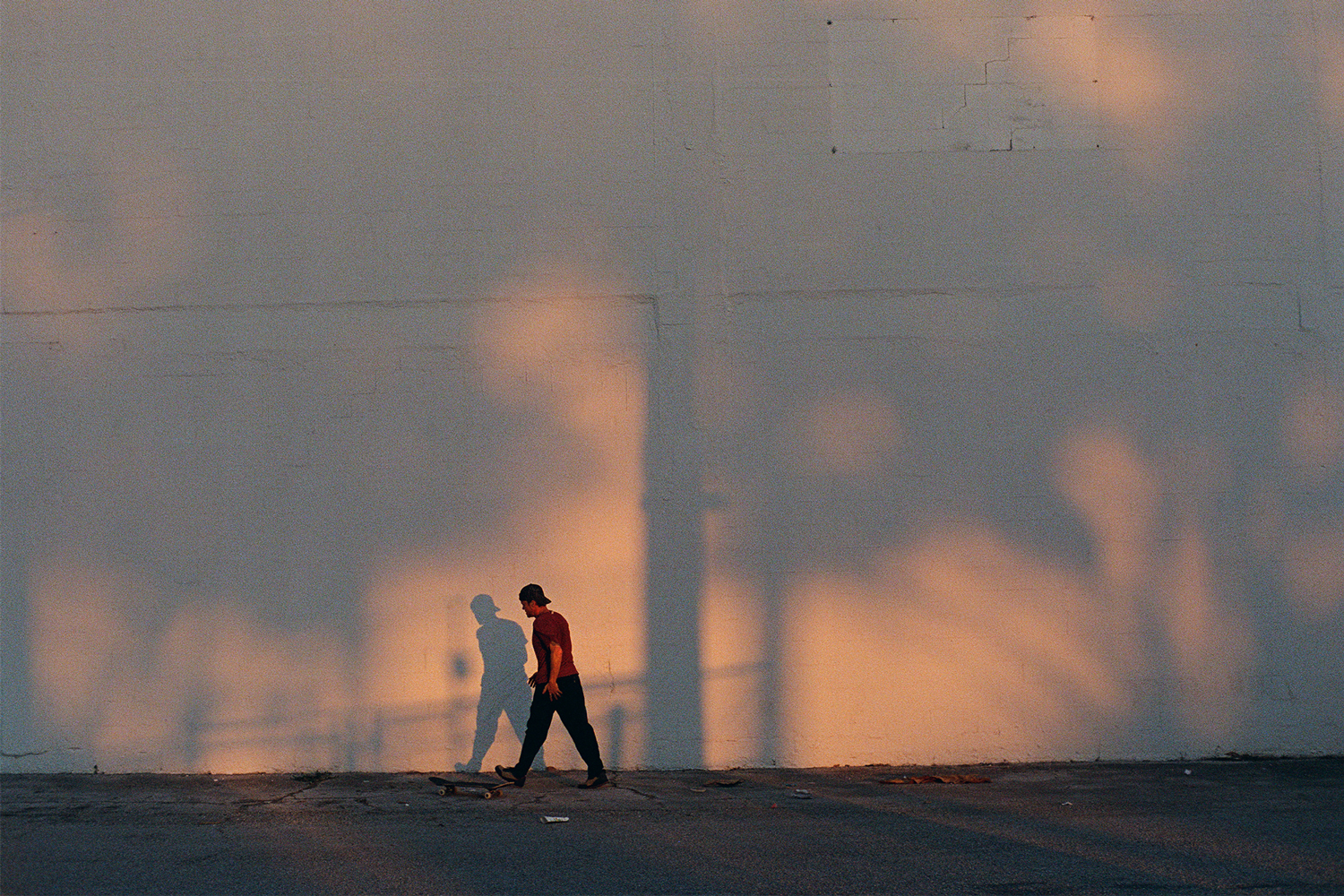
In 2024, Brad Cromer began uploading videos to YouTube which capture the relatable mundanity of his home life in Miami, Florida. Across scenes of skateboarding and local surroundings, there’s a tranquility that permeates from Cromer’s self-filmed slices of life where the soundscape of his skateboarding is as mystifying as the act itself.
Story by Finn Anderson
Headline photo by Matt Price
Videos and stills courtesy of Brad Cromer
Click the visuals throughout to play or pause excerpts from Brad Cromer’s videos. For the best experience of this article, please turn up your volume or use headphones.
Brad Cromer wakes up and waters his lawn.
Feeds his cat.
And skates a few curbs and local spots.
In the afternoon, he measures up some Levi’s Silvertab jeans for sale. At night, he throws on Heath Kirtchart’s Epicly Later’d episode.
“Nothing too special,” he writes of these events from rain later, a video uploaded to his YouTube channel in March 2024. “Just some solo skating, the beach, and some things around the house.”
Watching, you’ll likely agree: nothing too special. Compared to Cromer’s stacked resume of video parts, signature shoes (and pants), and long-term tenure at Krooked Skateboards, what we see in rain later may appear trivial.
Yet the opposite is true: rain later represents one of the most significant turns in Brad Cromer’s career — the culmination of over a decade of unrest.
“nobody really around the last few days here in miami so i figured id film a few things with my phone and throw it on here. nothing too special.
“just some solo skating, the beach, and some things around the house. i kept this one raw without a song.
“i plan on making a video solely on my vintage clothing collection. maybe some more skate heavy videos.
“i have some ideas.“
Brad Cromer
(March 17 2024)
“It’s just me, in my truck, with my skate stuff.”
— Brad Cromer
In 2011, Brad Cromer vocalised a distaste for moving to California to “make it” in skateboarding, believing he’d live in Florida his whole life — only to leave a few years later for Los Angeles, then New York City. Neither truly suited him. In his episode of Headspace, a series of video profiles of the HUF team, Cromer explains that his last few months in NYC led to a period of self-reflection and unhappiness, feeling “stuck” and “super confined.”
The video ends with Cromer watching an Instagram clip of Bill Murray. “When you catch yourself in that mirror,” says Murray, “you see the state you’re in. Are you happy, are you sad, are you confident, are you rosy, are you beleaguered…. Are you here? And most of the time you’re not. It’s almost like you want to look away.” This audio clip juxtaposes an image of Cromer in Miami.
‘Headspace featuring Brad Cromer’. HUF Worldwide, dir. Tyler Smolinski
The relatable mundanity of events in rain later voice a resolute end to Cromer’s transient 20s and early 30s. The message is clear. He’s in Florida now, here now, for good. The expected “norms” of the skate industry no longer loom overheard. He’s staking his ground back home.
In parallel with these locational changes, rain later marks a distinct shift in Cromer’s approach to skating. Though Cromer had a casual presence on YouTube from 2008 to 2020, his channel went silent from February 2020 to March 2024. When rain later emerges, it redefines the channel’s output and aesthetic. Cromer begins uploading a new video every other week, curating a channel complete with viewer outreach and engagement.
It’s a pro-skater move we’ve seen frequently in recent years: Tom Asta, Kader Sylla, Pedro Delfino. But nobody is “doing YouTube” in quite the stylised way Cromer is. Ryan Lay‘s ambient adventures share some tonal similarities, although what he captures feels more of a call back to an earlier era of the internet when social media could function as a public facing personal diary. Something of a video form of Tumblr that’s shared in Nelly Morville’s low-def output.
Cromer’s videos, however, exist somewhere between art and documentary, an antithesis to YouTuber culture, seeking to resonate at an emotional level with his audience.
“biking to a “spot”. joel [meinholz]’s barrier with jake [johnson]. [jason] dill pad. and a bump to can. with some things sprinkled in between.
“im trying to post something every sunday. it wont always be skating. this is just something fun to work on in between filming for bigger projects.
“if you enjoy these videos, like, subscribe, and leave a comment. question for the viewers… do you like more raw content or would you rather me start using music?“
Brad Cromer, j’s (March 31 2024)
“That’s one of the nice things about making these videos,” says Cromer, speaking over a video call. “It’s just me, in my truck, with my skate stuff.” He smiles, widely. “It’s so simple. Maybe it’s ‘therapeutic’ [to viewers], but it’s therapeutic for me. Maybe that shows naturally. That’s what gets me out to do them.”
Skateboarding, spiderwebs, graffitied highrises, snow-white egrets, public fountains, hot rain, bingo, philodendron, a jet-black cat and a cherry-red F150, lawn care, ice baths, Spongebob Squarepants, vintage Silvertabs, discontinued Jack Purcell mids, Seinfeld, flaneurship, The Artist’s Way… taken together, these scatterings seem like a “vlog.” To the skate community, however, they are much, much more. “It’s none of that blogging bs,” writes one commenter, “It’s actual art.” Others claim his videos are “the most brilliant vision of pro skater art” and “the ideal form of skate content.”
What these comments perhaps articulate is Cromer’s sense of authenticity. Patrick O’Dell’s Epicly Later’d normalised watching pro skaters in their “normal” lives decades before appearing on video podcasts and camera-facing content became part of the job. But it’s abnormal to see a pro skater skating alone, doing normal stuff alone, without a camera crew or production team.
“im trying to get this channel monetized. believe it or not, posting something every sunday is tough. filming for these videos takes away from having clips for instagram. i do enjoy filming and editing these. hopefully more to come.”
Brad Cromer, volcano peels (April 28th 2024)
In this cinematic niche, Cromer manages to collocate dignity with nostalgia, loneliness with celebration, wilderness with solitude — and rekindles in his viewers a spirit of skateboarding largely ignored by mainstream skate media. Watching his videos, I am often reminded of the book Vox Clematis in Deserto by Ed Abbey. The title’s translation: “A voice cries out in the wilderness.”
Here, “voice” is used purposefully, because what most characterises Cromer’s compositions, compared to other skate media, is his ambient soundwork, not his visual material. It’s tempting even to claim that his channel is more “about” sound than anything else. Take for example water, uploaded Valentine’s Day, 2025. In its first thirty seconds, Cromer interlaces ambient skatesounds with traffic, then swaying trees, then with wheels across tile. Images transition in chops and hacks, but sounds merge and inform one another, resulting in the audience’s ASMR-like lull into a “therapeutic” or “soothing” mood, as his comments often mention. “It’s the sound layering that does it for me,” writes one commenter. The percussiveness of a well-popped trick. The skirt of a powerslide. The flick of a lighter and the fray of palo-santo.
“its been a bit since i posted a vid in this style. i was in NYC for 20 days and was too busy there to film anything for youtube. i ended up taking a pretty crazy slam, and havent skated until a few days ago. it still hurts to skate. heres some random shots mixed in with a few mellow solo sessions.“
Brad Cromer, 🤘 (June 2 2024)
“Visually and audio-wise I want it to be clean.”
— Brad Cromer
“I pay a lot of attention to sound in general, day-to-day. I’ve left a spot because of noise before,” says Cromer. In making his YouTube videos, sound is crucial to his creative process. “If there’s a dude with a leaf blower, I’m going to restart or wait it out. I don’t want one trick to blare and then the next one quiet. So visually and audio-wise I want it to be clean, easy to listen to. It’s more where I filmed [the trick] is where I’m paying crazy attention.” Cromer credits former HUF videographer Martin Reigel, who introduced him to J and L cuts — slightly overlapping and gently fading audio from clip to clip — as the key to crafting a video that’s as easy on the ears as it is the eyes. “It was the best tip ever. I used that when I made lo-fi. Everything I’ve edited since I’ve meshed that audio so it’s a clean transition.”
Cromer’s ambient soundwork coincides with recent discourse in skateboarding’s burgeoning scholarly community, particularly with what theorists call “skatesound.” In “The skater’s ear: a sensuous complexity of skateboarding sound” sociologists Paul O’Connor, Brian Glenney, and Max Boutin sought to better understand skaters’ approaches to the noises they make with their boards. Notably, O’Connor and co. discovered that skaters “held opposing understandings of skatesound,” crediting it as both a pleasurable sound and an aggravating noise. In a separate study, the same research team writes that “a skater produces a kind of music, and an ensemble of skateboarders behaves like an orchestra, but one that appears abrasive to the public.” They call this the “skatesound paradox.” We skaters care a lot about the noises we make (Tiago Lemos says sound is crucial for a good ledge spot) but the line between unpleasant “skatenoise” and pleasurable “skatesound” is extremely vague.
“rained almost every day since my last upload. thats summer here in miami. my channel just got monetized. thank you guys. that means i wont be posting playlists anymore due to music rights.
“its too tough for me to post these skate vlog style edits once a week so i will be posting these every other sunday.
“i am going to try and think of a replacement for the playlists, hopefully having something to post weekly. im open to suggestions.”
Brad Cromer, hi buddy (June 16 2024)
Whether Cromer’s viewers perceive it in those terms or not, his channel stands out for its ability to alchemise the abrasive noise of skateboarding into a composition of sound. Try closing your eyes and listening to Cromer’s videos; it’s the type of soundscape that belongs on a meditation app. And it turns out that “skatesound” is quite valuable to consumers of skate media. In the “Skater’s ear” study, participants were prompted to watch Ray Barbee’s part in Powell-Peralta’s Ban This (1989). Though participants could acknowledge the part’s beauty and significance, they still found its lack of skatesound “problematic and disappointing.” As viewers, it’s unnerving to watch someone skate without being able to hear their skateboard.
Yet the same can be said for a skate part that only has skatesound and no soundtrack. Music is crucial to our cultural valuation of skate videos. When Baker Skateboards’s Bake and Destroy was released in 2014 , my friends and I thought Andrew Reynolds’ choice to avoid music was cool but underwhelming. Later, as if to give the footage what it deserved, Quartersnacks remixed the part to Chief Keef’s “3Hunna,” making it the only part from Bake and Destroy to get a re-edit. One researcher even claims that music acts as a form of “legal dope” athletes and brands can use to increase their impact.
Dylan Rieder: Style Was His Soul by Kyle Beachy, an excerpt from The Most Fun Thing: Dispatches From A Skateboard Life
A song choice can be as influential as a skater. I’m unsure what changed my life more: Dylan Rieder’s impossibles or Graham Nash’s “Better Days.” The same for Nick Trapasso with “Watching the Wheels.” You likely have your own examples as well.
Taking these ideas in confluence, it’s clear that the skate video as a medium necessitates both skatesound and music in order to “succeed” in terms of market expectations. And it’s important to pay attention to this. Theorist Dax D.Ozario points out that skate videos are the sport’s “primary source for subcultural capital,” both coding the consumer marketplace and enacting a form of cultural “peer-review.” Music and skatesound play enormous roles in “stoking” the viewer/consumer toward a particular outcome.
“my truck was in the shop, i got sick, its a million degrees, and it rains at least once a day.
“beyond those things i just really havent had much motivation to film for these videos. im going to film when it feels natural and upload whenever i feel i have an edit.
“im not trying to play the algorithm game. like, subscribe, all that bs.”
Brad Cromer, coral way (July 11 2024)
“What’s so inspiring about watching Brad Cromer skate flatground alone, without a soundtrack?
Why do I get hyped watching him water his lawn?”
— Finn Anderson
In this context, then, one would think that Cromer’s ambient, music-free edits would be less a powerful agent of “stoke” than conventional skate videos and parts, but that’s not the case. One commenter on Cromer’s channel writes: “This is what we need, some quiet, slow, simple footage […] That’s inspiring and makes us want to take our board and find some micro-spots nearby.” Another says it “Makes me want to go skate way more than most parts on Thrasher.” Comments like these suggest an interesting tension. Skate videos seem to exist to generate cultural capital and typically do so through fast pacing and a tasteful soundtrack. So, why does Cromer’s ambience and low-impact skating elicit such a reaction? What’s so inspiring about watching Cromer skate flatground alone, without a soundtrack? Why do I get hyped watching him water his lawn?
I believe the answer has to do with Cromer’s subversion of the long-held belief that skateboarding is inherently social.
Rodney Jones argues in “Sport and re/creation: what skateboarders can teach us about learning” that “learning how to shoot, perform in and edit video is to some extent part of learning to be a skater.” Watching and making videos is the mode through which we create and workshop our “skater” identities. The traditional precondition to creating videos, however, is companionship. To make a video, you need both a skater and a filmer. For this reason, skating is simultaneously an individual sport and a team sport, contingent on both the skater’s talent (the “individual”) and who they associate with (the “team”). This is why skateboarders possess such a “get in the van” culture of inclusivity; we celebrate our individuality, but we define ourselves by our “crew.” One participant in the “Skater’s ear” study felt so strongly about skating’s social axis that he policed people for skating with headphones at his local park, since “when skateboarding you were participating in a communal activity.”
@bradcromer (April 2020)
Self-filmed vlogs or IG clips disrupt skating’s “communal” status quo, but don’t fully subvert it. The Covid pandemic proved you don’t need a “crew” to film a skate video. The faux-pas of selfie-filming became a norm. “I didn’t really skate alone, honestly, before lockdown. I was in New York City at the time and we all know that was maybe one of the craziest places to be. At least right in the beginning. It was straight up freaky. Ghost town. People moved, no one left their houses. It was pretty psycho”, says Cromer.
“I have to do something, that’s when I first started filming myself. I didn’t want to jeopardise anyone. So I bought a bike and I would bike around my zone, East Williamsburg, or pop into the city and it was just literally a ghost town. Because of the situation, I would start filming myself but those would end up on my Instagram story or I would make little edits, a hard post. I’ve filmed myself before this but that came into an option for me around then.”
“Have you considered sending a tape over to the guys at Krooked? You seem to know your way around a skateboard”
“most tasteful / watchable self-filmed skating i’ve ever seen. really creates a vibe”
“Damn I love watching these little edits. Dig the artful, meditative quality…not to mention the selection of spots steezy flatground hardflip”
“These home style videos must be pretty fun to make. No pressure from a filmer or anybody, you can just set up somewhere and go at your own pace.”
YouTube comments on s c o r c h e r
(July 11 2024)
This uptake of solo filming didn’t necessarily lessen skate media’s implicit sociability. Popular pro skater vlogs like Ish Cepeda’s, Pedro Delfino’s, or Chris Joslin’s may be self-filmed, but they still depict the life of a pro skater as one surrounded by a “crew.” Likewise, these self-filmed YouTubers often nurture parasocial relationships with their viewers by speaking directly to the camera or through other “influencer” styles of engagement. This behaviour reinforces the idea that skating’s meaning-making is social.
Cromer’s channel, however, is categorically crew-less. Though friends like Jake Johnson and Brian DeLaTorre make unannounced cameos, Cromer’s depiction of pro-skater-ism doesn’t present sociability as a prerequisite for meaning-making. Rather, his channel seems to suggest the opposite. Often the most meaningful moments in Cromer’s videos occur in private, such as, for example, when Cromer lingers his lens on his t-shirt in ◡̈, meditating on its decay, or when a random man on a scooter speeds by in s c o r c h e r. These are profound moments that create their meaning from the quiet “out there-ness” of being a flaneur-skateboarder in the urban wild, regardless of crew.
“Brad Cromer’s withdrawal of his face contrasts the dominant ethos of skateboard filmmaking, which ever since Supreme’s “cherry” has hierarchised the face first, the trick second, and the spot third.
Cromer is: sound first, spot second, trick third.”
— Finn Anderson
On top of this, Cromer avoids an interpersonal relationship with the camera. Although his channel is implicitly about a public figure — the pro skater Brad Cromer — he goes to great lengths to avoid positioning himself as its foremost subject. Rather than himself, his compositional protagonist is Miami.
Concrete, infrastructure, flora, skate spots. Cromer skates through each composition like a passerby, never speaking, never narrating, often skating with his back to the camera, often obscuring his face with a low-pulled vintage ballcap. He’s a YouTuber without a “YouTuber” persona. Even in his “vintage haul” videos, whose genre demands a more persona-forward style of YouTubing, Cromer avoids eye contact by holding his t-shirts like a curtain between himself and the camera. He’s there, but behind himself. Photography theorists note that faces in visual compositions posit an image’s “calculated drive for symbolic order,” determining the viewer’s hierarchy of meaning.
Cromer’s withdrawal of his face contrasts the dominant ethos of skateboard filmmaking, which ever since Supreme’s “cherry” (2014) has hierarchised the face first, the trick second, and the spot third. Cromer is: sound first, spot second, trick third, Cromer last. “I guess it’s me not trying to be swayed by the way you’re ‘supposed to’ do it,” he explains. “You’re ‘supposed to’ skate to this, you’re ‘supposed to’ say ‘What’s up guys?’ for the YouTube video. I’m going to stay in my, like, comfort level of YouTube-y-ness.”
“this and that from the last couple of months. a lot of people visit miami this time of year, so ive been more focused on getting out with friends and seeing if i can film things for a future video part. my toe is still giving me trouble, but ive managed to get a few tricks i feel are usable. if you enjoy these edits, let me know. thanks for watching!”
Brad Cromer, water (February 14 2025)
But look closely and the subtle signs of a persona are still there: the cherry-red Ford. The Silvertabs. The discontinued white Purcell mids. Over time, these subtle clues begin to ingratiate the viewer to Cromer. He is humble. He is intentional. We respect that. (Ironically, such persona-less-ness might even work as a marketing tool. His discontinued white Purcells, for example, seem to embody persona-less-ness itself — a blank white unknown, lacking sellability. Yet many of his commenters ask where they can buy them.)
Hilariously, Cromer’s on-screen withdrawal makes for some confusion in his audience. Younger viewers, raised in an era when persona precedes talent, don’t think Cromer is a pro. “i love these videos bro i hope you blow up one day” [sic], writes one fan. Another says, “i really like this video. man I wish I could skate like you, you skate like a pro in my eyes” [sic]. Quickly, someone else jumps in: “He literally is pro for crooked” [sic].
Having followed Cromer for years, such persona-less-ness feels restitutionary. Somewhere in his mix of sound, flatground skating, and solitude, Cromer is proving something important, but often neglected, about skateboarding.
“I come back to these videos when I have a really rough day. Calm me down. Remind [me] things are beautiful”
“So refreshing seeing a pro doing youtube videos without aiming for views. Just good skateboarding straight from the heart”
“There’s nothing cooler than watching you rip the old neighborhood. Seeing you skate spots I’ve passed millions of times is so satisfying- places I couldn’t make anything happen at, but you make it look easy!”
YouTube comments on fakie bigspin (May 9 2025)
As one commenter writes, “This reminds me of the videos that people make of building shelters in the middle of the jungle.” YouTube scholars call such media “slow living” content, which focuses its viewers’ attention on craftsmanship, subsistence living, and premodern authenticity. The majority of slow living channels’ comments, like Cromer’s, mention how relaxed the viewers feel, how soothed, how nourished, or how much they’ve learned about a craft. The mission of slow living media is to demonstrate and celebrate how things were done before modernity came and made everything so complicated.
Framing Cromer’s videos as “slow living” content suggests an interesting point about skateboarding media — that the meaning of “stoke” has begun to change. I certainly notice it myself in my own life. With the caliber of skating being so high now, and its star personalities so bourgeois, “skateboard media” and “skateboarding” exist in two separate corners of my life. “Skateboarding” — that thing I used to put so much of my time into — has more and more become something I do only when I have the time. Maybe a quick session after work, alone. Or a push to the grocery store. But watching skate videos is something I do much more often: on the train to work, on the couch after a long day. I rarely watch skate videos to get “stoked” to go skateboarding. The media and the activity itself have begun to split apart.
” i have a friend & filmer in town for a bit longer. were trying to get a solo project going together. im excited to start something new. i always like to have some sort of vision of what im working on. i have a hard time just going out and filming to film. ive never been a fan of sprinkling my footage around into different videos either. so, to know we have a video part in mind gives me motivation.
i hope everyone is doing well. i know this time of year can be hard for some people. 2025 was a rough one for me […] im trying to be hopeful and just keep things moving. not much else we can do. keep on truck’n… at 0 mph, hahahaha.
Brad Cromer, pink and blue, January 1 2026
But watching Cromer mends them together again. In his rapid-fire, staccato style of filmmaking, with Cromer-the-pro-skater receding into the background of the subject composition, it takes me only a few moments before I find myself superimposing my bag of tricks on whatever spot Cromer skates, visualizing his movements as a proxy for my own. What would I do at the spot Cromer is skating? Could I do it as well as him? The lack of music only sharpens this vicarious learning. O’Connor, Glenney, and Boutin of “The Skater’s Ear” note that “When one hears a successful completion of a trick, like a long grind across a ledge, they simulate the experience in their mind, imagining their own body doing the trick.”
Beyond this, Cromer’s willingness to portray himself in utter solitude — away from skating’s in-crowd — invites viewers’ introspection, granting an “accessibility” that transcends the physical. When was the last time I went street skating alone? Why don’t I skate alone more often? Why does skateboarding always have to be social?
Implicit questions like these lend the channel a sensitivity for discourse about mental health. Scrolling through Cromer’s comments sections, you’ll notice many viewers sharing personal trauma or challenges. “Fucked up a job interview today but this helps cheer me up,” writes one fan. Another claims Cromer’s videos are “like therapy for me.”
“Most skate videos still serve their traditional function to “stoke” audiences and sell products, videos like Brad Cromer’s suggest viewers turn to skate media for much deeper psychological reasons.”
— Finn Anderson
And this is where Cromer really shows himself. If his videos lack a YouTuber persona, he compensates by writing back to his audience. Cromer likes and responds to nearly every comment on his videos. Sometimes he even shares intimate details. On one video Cromer posted, a commenter spills: “I am currently in a period where Im trying with all my might not to fall into a depressive episode again and even waking up in the morning is torture for me, but now I want to keep this music in my head so I know what to live for.” Cromer writes back the very same day. “aww man, hang in there. it happens to the best of us. [sic] i deal with depression and anxiety myself. […] life is beautiful amidst all this craziness.”
Taking this emotional sensitivity in tandem with Cromer’s soundscapes and flaneurship changes our understanding of the purpose of skate media. Though most skate videos still serve their traditional function to “stoke” audiences and sell products, videos like Cromer’s suggest viewers turn to skate media for much deeper psychological reasons.
“These videos are good for the soul”
“The ambient sound master” “
“Thank you for making these Brad. Always a pleasure to watch you skate/exist.
“Speaking without saying a word”
Comments on fakie flop (March 2 2026)
Personally, Cromer’s solitary, ambient soundscapes transport me back to my adolescence in our small Californian town. Back then, we didn’t have the internet. We didn’t have cable TV, either — just a VCR. My house was boring. Life in general was fairly boring. But we did have a small ten-by-ten-foot section of smooth concrete in front of our house, where, when we’d get home from school, my brother and I could skate around in circles. At the time, skating was something we did when we were bored, always in silence. No music. (Listening to our Walkmans would’ve been cumbersome.) After some months of cajoling each other and bruising our shins, my brother discovered he could kickflip. I learned some time later.
What’s so powerful about Cromer’s channel, then, is his ability to remedy this common pitfall of the internet age through the very medium responsible. What Cromer’s videos remind us of most, I think, is that the point of skateboarding isn’t to be popular or “stoked,” but to experiment with one’s own bored solitude. Isn’t this our origin? Don’t we all begin alone, bored outcasts in our driveway, trying to learn a kickflip? And isn’t this solitary just-for-the-fuck-of-it experimentation the real difference between a “sport” and an “art”? This, I think, has always been what’s so exciting about the idea of skateboarding. “Art” means you get to do whatever you want. And, “Art” often means a lot of time alone.
Watching Brad Cromer reminds me of these things. And in this quality, I think, exists his richest importance to our sport. Strangely, Cromer’s greatest success might be his ability to get us not to watch him. I’ve found the longer I watch Cromer, the more I’m reminded of my own lonesome city and the possibilities there. What could I discover? Compelled, I shut my computer. I go skate.
Finn Anderson is a lecturer in undergraduate writing at Columbia University. ‘Brad Cromer’s Lonesome Crowded Florida’ is his published article about skateboarding.
Got the time for another long read?
“Suppose that, by knowing his friend so well, and going out shooting with him and editing that footage and presenting it as he did, Greg Hunt achieved that most impossible thing — he gave us a way of knowing another person without ever meeting him.” — In a heartfelt essay from The Most Fun Thing, Kyle Beachy considers style, soul and the legacy of Dylan Rieder.
“It’s that, married with physical talent, which makes a good skateboarder. But I do think it’s the personality bit that’s more crucial. And that’s where the interview comes in. It explores that very thing.” — Question and answer interviews have long been a predominant format for written skateboarding journalism. To unpack how they became so ubiquitous and decipher what, exactly, makes for a good one, the script was flipped on Eric Swisher (“Chops”) of The Chrome Ball Incident.
