
Globally revered and revived by Steve Rodriguez leading a years-long fight to preserve concrete culture, the Brooklyn Banks are back. Now, a cross-generation of locals shared what the space means to them.
Story by Tyrese Alleyne-Davis
Photography by Greg Navarro
To the clichéd ideal of skateboarding, synonymous with California and cultivated in backyard bowls throughout the 1970s, the Brooklyn Banks are an ineffably cool East Coast doppelgänger.
The stretch of curved bricks beneath the Manhattan side of the Brooklyn Bridge which were localised in the 1980s, and buried by maintenance in the mid-2000s, are now restored after over a decade of closure to the public. Today, the Brooklyn Banks stand as a monument to contemporary street skateboarding: the act itself and culture’s emergent civic guardianship.
Most importantly, the Banks are again becoming part of the identity of a generation of New York City skateboarders.

The Brooklyn Banks in June 2025 by Kevin Horn
For Queens-born Elisa Martini, 19, the reopening of the Brooklyn Banks is more than monumental. It’s personal. “The Banks have been around for a super long time,” says Martini, speaking at the spot to a backing track of laughter and the rapid fire of clack of wheels on brick, occasionally punctuated by the screech of a wallride on the base of the Manhattan Bridge’s support pillars. “I started skating a couple of years ago and that’s when I first heard about them. But I never got to skate it before now because it was fully closed off due to construction. It’s a huge part of skateboarding history and a huge part of New York history.” She had only heard the stories and seen the spot in videos, “So to see it open back up, and for me to be skating it for the first time properly, is really exciting. The fact that it’s reopened and skaters are welcome again is amazing. It’s becoming a true community spot again, like it once was.”
“It’s a huge part of skateboarding history and a huge part of New York history … That it’s reopened and skaters are welcome again is amazing. It’s becoming a true community spot again, like it once was.”
— Elisa Martini
Elisa Martini wallrides at the Brooklyn Banks whilst filming for Bronze 56K
Martini brings not only talent, but perspective. She credits Steve Rodriguez, 5Boro Skateboards founder and longstanding advocate for New York City skateboarding, for making the return of the Brooklyn Banks possible. “I’ve known Steve since I started skating. Aside from the Banks — which is already huge — he’s supported New York skateboarding in so many ways. He’s put on events, created opportunities, supported skaters, and just kept the scene moving forward. Bringing the Banks back was nothing short of a miracle.”After a 15-year shutdown, swallowed by scaffolding and housing construction vehicles attending to the Brooklyn Bridge, the Brooklyn Banks officially reopened on June 5, 2025, folding back into the city’s fabric like a memory unboxed.

Steve Rodriguez and Ted Barrow PhD, art histortian and host of the architectural docu-series ‘This Old Ledge’ which is produced by Thrasher Magazine. Greg Navarro
At the heart of that resurrection is Rodriguez, who rose to prominence during the 1990s. A New Jersey-born skater with a deep love for the city’s unique grit and aptitude for engaging with local policy, Rodriguez became a leader and organiser. For the skaters who watched him grow from teenager to community pillar, his decades-long fight to restore the Banks isn’t just an act of civic engagement, it’s a full-circle moment rooted in love and loyalty.
Rodriguez’s relationship with the Banks began in the summer of ’85, when he followed Harry Jumonji through Lower Manhattan and turned the corner onto Park Row. What he saw would change the course of his life. “It felt like something we could own, something that belonged to us,” says Rodriguez. “No one was kicking us out. It wasn’t like Washington Square Park or somewhere with security or cops. This was a magical place. Just skateboarders doing their thing.”
“It felt like something we could own, something that belonged to us. No one was kicking us out. It wasn’t like Washington Square Park or somewhere with security or cops. This was a magical place. Just skateboarders doing their thing.”
— Steve Rodriguez
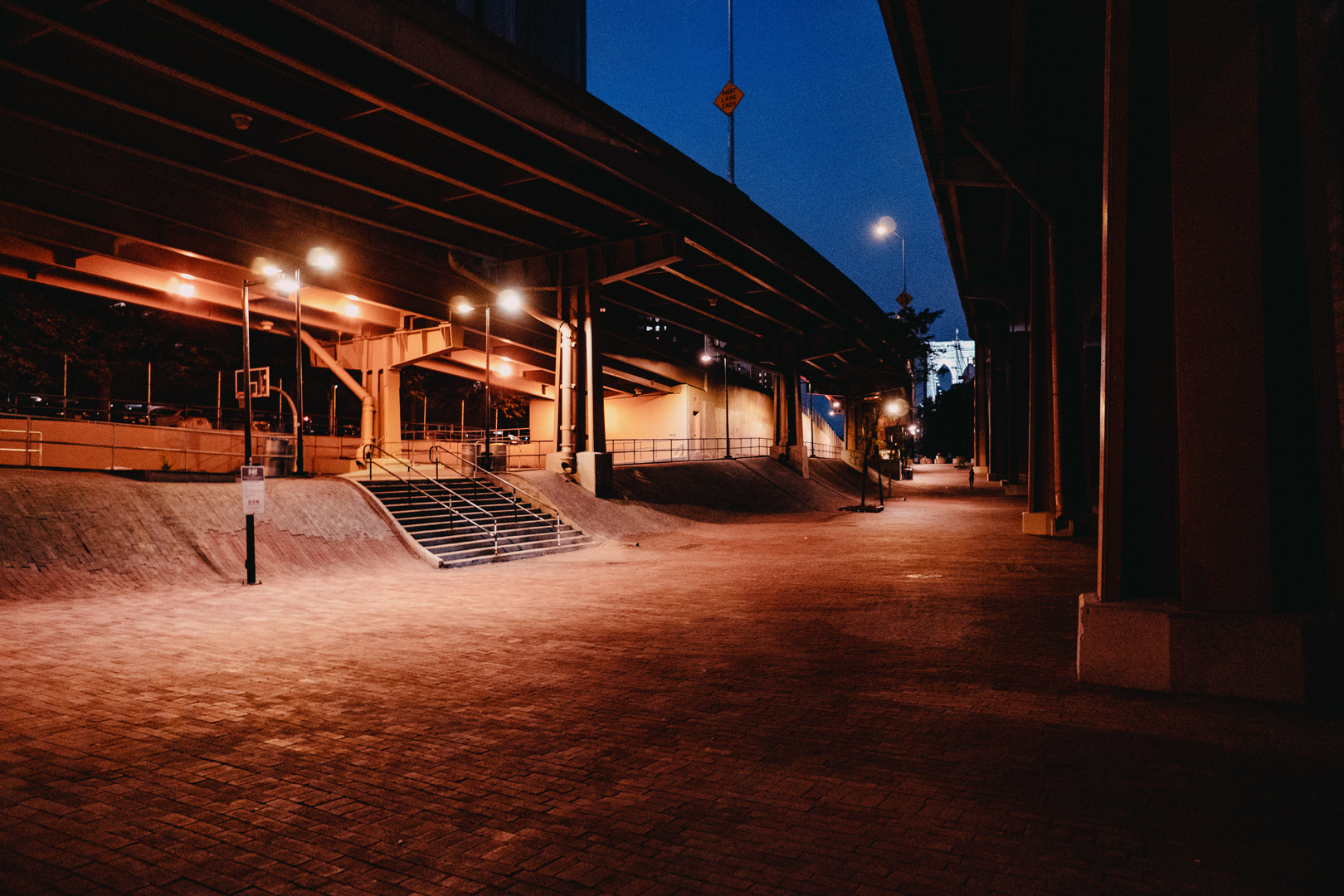
The Brooklyn Banks in tranquility before their public reopening. Greg Navarro
That sense of freedom, of skater-led creativity, would become the foundation for everything Rodriguez fought to preserve. When barriers went up in 2004 for a DOT renovation, he couldn’t just watch the Banks disappear. He reached out to the Parks Department, formed a nonprofit, built coalitions with local residents, and navigated red tape with city officials and sponsors like Vans and The Skatepark Project (formerly, the Tony Hawk Foundation who contributed to the rebuild of the Lower East Side Skatepark which Rodriguez was also involved with). Their return is of the Brooklyn part of a space known as Gotham Park, a public urban area which integrates skateboarding, allowing the Brooklyn Banks to be restored verbatim and carrying its original soul. And over two decades, this mission evolved from a personal cause into something more resounding. “I skated with some guys from Germany and Japan recently who came here just to skate this spot. So it’s more than local, it’s global.”
But for many in New York, the impact of Rodriguez’s work is felt most profoundly at the street level by the skaters who’ve looked up to him since they first stepped on a board. Eli Ritter first skated on the Brooklyn Banks as a middle schooler. Returning to the spot this summer after years of closure, now aged 36, Ritter couldn’t believe what he saw. “When I heard it was reopening, I was skeptical. I thought they might smooth it out or modernise it too much but I’m super thankful they restored it to its original state. It feels real again.” For Ritter, that authenticity is inseparable from Rodriguez’s vision. “He’s a hero — straight up. Not just for the Banks, but for the NYC skate scene overall. We all understand what a heavy lift this was. We’re eternally grateful. What he’s done will have a butterfly effect. Generations of skaters are going to benefit from this.”
Nelly Morville and Curren Caples skate the Brooklyn Banks ahead of their reopening. Vans
Similar sentiment is echoed by Dave Feldman. He’s been skating the Brooklyn Banks since high school, traveling every weekend from Westchester, NY back then to what he describes as an “amusement park” for street skating. “To see it come back again,” says Feldman. “It goes well beyond the area. I’m coming out from Jersey City today. This place has that kind of pull.”
Feldman sees the restoration of the banks as community service but also cultural preservation. “To preserve a spot that wasn’t officially meant for skateboarding but still served as a home for so many of us? That’s something else entirely. To bring that back makes this whole thing huge.” His memories are laced with clips from iconic videos like Alien Workshop’s Photosynthesis where mythic energy of the Banks were broadcast, palpably, to skaters around the world. “Brian Wenning’s switch 360 flip [down the 9-stair], Anthony Papplardo’s nollie half cab over the big rail [in Photosynthesis], those clips were everything. I was a suburban kid watching Zoo York’s Heads and thinking, “I’ve gotta be a part of that”. And now here I am.”


Left: Brian Wenning, switch 360 kickflip at the Brooklyn Banks 9-stair for a Habitat Skateboards advert promoting Alien Workshop’s video, Photosynthesis, 2000. Photography by Ted Newsome, design by Joe Castrucci. Scan courtesy of The Chrome Ball Incident
Right: Jaime Reyes, frontside boardslide at The Banks by Giovanni Reda, originally published in Skateboarder Magazine, September 2001. Scan courtesy of Womxn Skate History


Keith Hufnagel, backside wallride, 2006 and Antonio Durao, switch backside noseblunt, 2024. Ben Colen
Another Dave (surname unknown), a skater and father, offers a different dimension to the Banks’ revival. Though he only got to skate the spot a few times before it closed, he always dreamed of sharing it with his son and until recently, that dream seemed lost. “I didn’t move to New York until about 15 years ago, and by that time, the Banks were already closed. I only got to skate it a few times early on. Then after my son was born and got into skating, I figured he’d never get the chance to experience this place. But now, with the reopening, he and a whole new generation of kids who’ve heard the legend of the Banks finally get to live it. That’s pretty exciting.”
“I know this took a lot of time, energy, and love. It’s clear this was a labor of love, and now kids are enjoying it again. We were here for Go Skateboarding Day a couple of weeks ago, and the vibe was incredible. To see that kind of energy regularly? That’s what it’s all about,” says Dave.
“After my son was born and got into skating, I figured he’d never get the chance to experience this place. But now, with the reopening, he and a whole new generation of kids who’ve heard the legend of the Banks finally get to live it.”
— Dave, father and skateboarder
Crowds gather at the Brooklyn Banks for Go Skateboarding Day 2025. Greg Navarro
Watching his son fall, try again, and grow through skating has been one of the most powerful parts of Dave’s life as a parent. “Oh man, it’s everything. Perseverance. Resilience. Learning how to try something scary, fail at it, and eventually land it. It’s also so creative—skating teaches you to see the world differently.”
Elisa Martini’s reflections on street skating attest to that. “If you skate in New York, you already know it’s tough. The ground is crusty, the spots can be sketchy, and you get kicked out all the time. You’re under pressure trying to land tricks in imperfect conditions. But you just have to keep skating.” Asked what she wants her future self to remember about this period, “I hope I remember how fun it was to skate here. I hope I’m still skating. And that I look back on these moments and see myself having a good time, pushing myself, meeting new people just making the best of it.”
Whatever generation they’re from, whatever year they first rolled on these red bricks, skateboarders at the Brooklyn Banks carry the same determination and creativity but also reverence for the place. “I hope I remember it as a monument to skateboarding,” says Eli Ritter. “A place where people came to get better, to push themselves outside of the comfort of a skatepark. I hope it stays a bit rugged and less crowded. And honestly, I’d love to take my kids here one day.”

Steve Rodriguez and Ted Barrow. Greg Navarro
Steve Rodriguez, too, has a message for the next generation: “Use this story as a model. Never give up. If you want to get something done, yes—work hard, but understand that things take time. A lot of perseverance. It’s not corny—it’s real.”
And that’s what the Brooklyn Banks is now: not just a landmark spot, but a symbol of endurance. A place where skateboarding’s past and future collide. Where kids from all boroughs still meet at the same bricks. And where thanks to a local legend turned guardian, the grind never really stopped, it just waited for the right push.
Tyrese Alleyne-Davis is a Brooklyn-based journalist and staff writer for the New York Amsterdam News sports section and Park Slope United Soccer Club. He covers Major League Baseball for Athlon Sports and runs Game on Wheels, a Substack blog spotlighting New York’s high school, grassroots, and adaptive sports scenes. A graduate of NYU with a degree in creative writing, Tyrese brings a narrative-driven lens to stories rooted in community, resilience, and culture.
Greg Navarro is a documentarian and cinematographer with passion for telling stories in skateboarding. Born and raised in Manhattan, he produces films for publications including Thrasher Magazine, Jenkem Magazine and Quartersnacks as well as running his own freelance video production business in New York City working on commercials and brand marketing.
If you would like to support Skate Bylines, you can share this story with someone who would enjoy it. Alternatively, you can buy us a coffee here.
We received this story as a pitch. If you have an article that you would like to pitch to us, or need some assistance in refining an idea, please get in touch. (You might also find our pitching resources useful, ‘Making The Big Leagues’ Part I and Part II)
If architecture is up your street
“It’s an accessible first point of, like, ‘How do I connect with this culture?’” — Ian Browning examines municipal space in New York City through the lens of his Quatersnacks story on the Lower East Side Skatepark in ‘The Civic Center of New York City Skateboarding’.
“What happens when a spot is destroyed forever? How, then, is its legacy preserved in a tangible form that goes beyond images and stories?” — Dominique Teoh explores the architectural concept of ‘spolia’ which “rubble into something both relic and resurrected” through a case study in Love Park and Love Malmö.
More from the Skate Bylines news desk
“My goal was to get a mix of well-known and lesser-known people from all areas of skateboarding culture that you didn’t see or hear in other skate podcasts” — Quentin Delille reflects on the highlight of Beyond Beyonds on account of the podcast’s 100th episode.
“Cats are pretty hard to wrangle” — A welcoming into the homes of professional skateboarders and their pets in Heckride‘s zine, Tres Leches.
“There are so many fun avenues we explored which we never would have done without [the company]. Isle is a moment in time, a beautiful thing we were all involved in.” — Nick Jensen reflects on the story of Isle Skateboards following the company’s curtain call.
Got the time for a long read?
“It’s that, married with physical talent, which makes a good skateboarder. But I do think it’s the personality bit that’s more crucial. And that’s where the interview comes in. It explores that very thing.” — Question and answer interviews have long been a predominant format for written skateboarding journalism. To unpack how they became so ubiquitous and decipher what, exactly, makes for a good one, the script was flipped on Eric Swisher (“Chops”) of The Chrome Ball Incident.
“Suppose Hunt managed to make a movie that conveyed Dylan Rieder as he was. Suppose that, by knowing his friend so well, and going out shooting with him and editing that footage and presenting it as he did, [Greg] Hunt achieved that most impossible thing—gave us a way of knowing another person without ever meeting him.” — Kyle Beachy skateboarding, style and Dylan Rieder.
You can Explore a range of stories across skateboarding media and in wider circulation with our Journalism Library.