
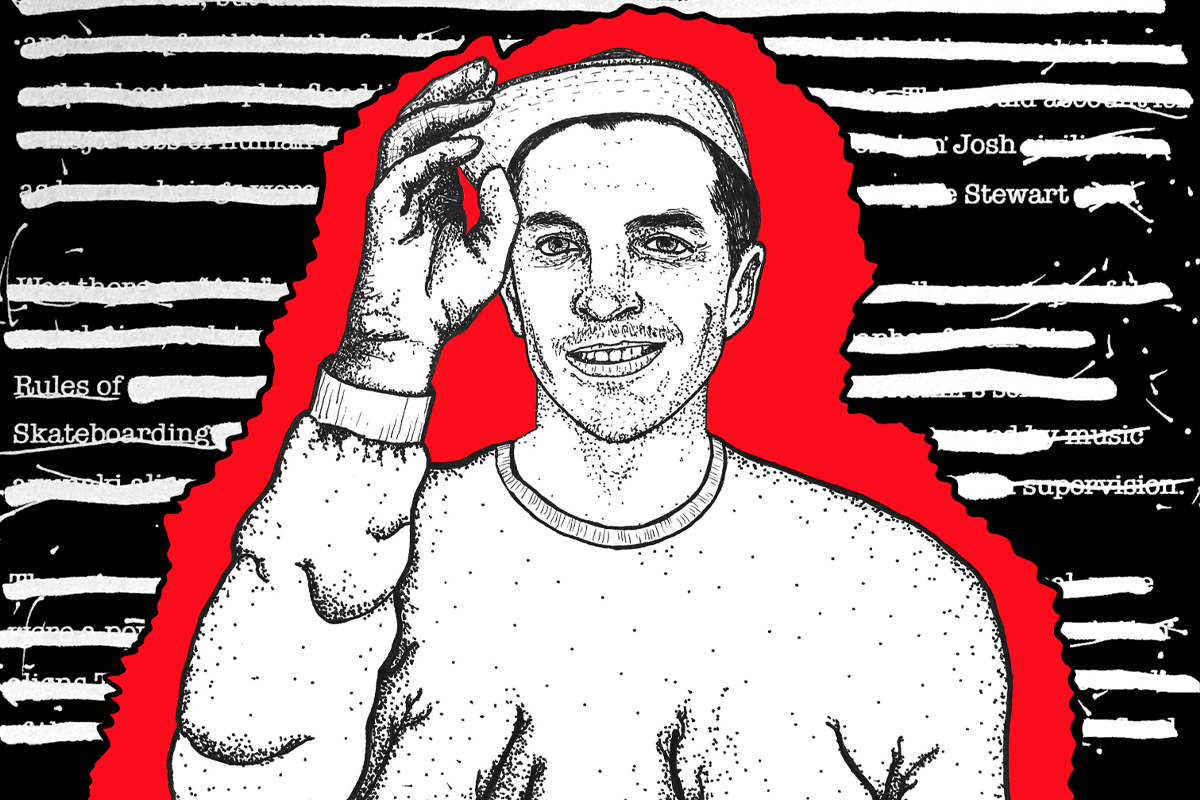
Josh Stewart — auteur of the Static video series, cuts through the noise and talks music supervision in skate videos.
This story is part of ‘New Year, New Rules’ which welcomes Ian Browning and his ‘Rules of Skateboarding’ column to Skate Bylines.
Interview by Ian Browning
Illustration by Christian Kerr
What videos would you consider to be classics? Specifically, videos that have stood the test of time because of they way they’re edited or the music they’ve used.
The most obvious example is Video Days. Also the Stereo video A Visual Sound. I guess it’s maybe a little too stylised because [jazz] music is going to annoy people at a certain point. But that one, to me, really stands the test of time.
It sucks because hip-hop heavy videos, especially in the ’90s, were so common. You know, like 20 Shot Sequence. Hip-hop will stand the test of time if it’s used in moderation, but it really dates things. I think Photosynthesis definitely is a really good example of using great music while still being safe in the sense that it’s going to last.
What do you like more: when the skater picks the music or when the editor picks the music?
It always depends. In my experience when the skater picks the music he’s not seeing it. It’s like a chapter in a book. So if a skater is just picking something and is like “I love this song and I have to skate to this song” it doesn’t flow. It’s like it’s own story that should be separate. Very often when a skater is really adamant, I’m terrified because it’s going to change that feeling that I’m trying to achieve.
But some of my favourite songs that have been in my projects were picked by the skater. It often brings something that I would have never heard before. That out of the box thing, like Ed Selego skating to Yellowman. He told me he wanted to use a reggae song in the Adio video [One Step Beyond, 2002] and it’s like “I don’t think that’s going to work…” Then the second you put it to the footage and you’re like “Oh shit!” Sometimes you don’t even think it’s going to work but you put it in a timeline and it’s clear that the skater is seeing something you’re not seeing.
I typically think that if it’s a video maker like Joe Castrucci [of Alien Workshop and Habitat Skateboards] who creates an overall experience, it typically works best when the filmmaker or editor is making those choices. But the left field suggestions from skaters sometimes are the best.
Joe Castrucci turned to friend and DJ Mr Dibbs to score an original soundtrack to the Habitat section of Alien Workshop’s Photosynthesis (2000) which he shot and directed. In this 2022 Bobshirt interview, Dibbs explains the process of scoring the part.
Looking back are there any music choices you regret in your videos?
Oh yeah, there are [laughing]. Absolutely.
Anything in particular?
I think almost every video has one of those. In Static [1999/2000], it’s a band called Mr. Bungle. It’s the guy Mike Patton from Faith No More, it was his side project. It’s like a montage—nobody will remember it because everyone skips it, I’m sure—it opens up with Mark Appleyard 360 flipping a double set on Super 8. That one was a bad choice.
In Static II, Paul Shier’s song by The Faint. I think he said he likes it still, but it dates it. It’s like every emo kid sitting in his room feeling sorry for himself in 2004. Wayne Patrick’s song in Static II. I like Modest Mouse, and I’m not embarrassed that I used a Modest Mouse song [“Breakthrough”], but it’s grating when I hear it.
You know, using The Shins in a Static video in hindsight, that makes no sense. [Ed— Kenny Reed’s first song in Static II] The idea is to use stuff that’s obscure that people have never heard before. I feel like Static II was one of those videos where, I’m not saying I learned my lesson, but after the fact I was really careful with music from there on out.

Even a maestro can make a mistake: Paul Shier in Static II by Josh Stewart (2004)
Background: Josh Stewart in New York City, somewhere between Adio’s One Step Beyond and Static II, early 2000s
What about reusing a song that someone else has skated to? What circumstances is that allowed? Are there any?
It’s kind of on your conscience, you know what I mean? Did you really not know that that song had already been used? Usually it’s an absolute no, because you’re hurting yourself.
In Static IV I almost used a song Andrew Reynolds skated to. I didn’t even see it! It’s Baker 2G. One of the ones that slipped past me. He skates to Donovan [“Get Thy Bearings”]. I had it edited and I was so hyped on how it went. I don’t show it to anybody and somehow Pat Steiner was in the office and heard it and was like, “You’re not editing to that, are you?’
“Yeah, why?”
And he was just like the emoji with the hand in the face. You almost always just can’t use it.
Hugh “Bod” Boyle’s section in the Santa Cruz / Speed Wheels video A Reason For Living (1990, left) was set of “Treason” by Naked Raygun. The song also soundtracked Ville Wester in Polar Skate Co.’s Sounds Like You Guys Are Crushing It (2022, right) and is one of several nods to late ’80s and early ’90s skate videos in the brand’s video catalogue.
But what if it was in something smaller, like, Logic 3? Is that still the rule?
If it’s something that was in one of those video magazine formats that does not affect the decision making at all. Especially now with all these Instagram edits and part releases. It’s so hard to keep track of it. It’s the same thing with tricks on spots. If it was a classic trick or a classic skater, you know if Guy Mariano did a trick on a spot, you can’t redo it. But these edits where every week there’s a new six minute edit of kids just ransacking New York City? It’s like, dude, I can’t keep up. At a certain point the rules have changed. It’s more on your conscience.
There’s a song in FTC Penal Code, they use a Love song for Max Schaff’s song and his part is literally like 12 seconds long. It’s such a bummer because I always have a list and that song is on my list and it’s like “Oh man, you could still use this because they didn’t really” and that’s one of my favourite videos ever so I never used it. That’s the other thing, if somebody does a song dirty you’re kind of like, “Well…”
Habitat Skateboards’ Mosaic by Joe Castrucci (2003)
I was going to bring up Super 8 and how at one point in time, in that Photosynthesis / Mosaic era that was the equivalent of what the VHS camera is now. At that point it was super saturated and now it’s representative of videos that are classics.
I see a shitload of indie videos. Every kid in America sends them to us. Every single fucking video where a kid is using a VX now and is in that indie world, every one of them still has Super 8 in it. It’s insane. Whatever lab is still processing Super 8 is just like, “What is going on? How is it still happening? We were going to shut this machine down.”
“We keep getting these kids bailing on kickflips.”
Can you imagine? That’s really come back heavy. Everything just gets saturated. It’s unavoidable now. Sam Salganik, in skateboarding, he should get credit for being the first to push the lo-fi look. And then Lev [Tanju] at Palace actually took it to the VHS realm.
Palace Skateboards used VHS cameras exclusively from their inaugural 2011 promo through to the their 2017 full-length production, Palasonic. In the opening to Lucien Clarke’s section (left), which is filmed at Victoria Benches, he skates to “Innerspace” by The Apples in Stereo”, an homage to Unabomber’s Headcleaner (2001) and Toby Shuall (right) who Clarke witnessed skate the spot firsthand as a child.
Do you think the VX is going that route too? Is it the next Super 8 or VHS camera?
I don’t think so because it never disappeared and came back. There’s a huge culture of filmers that never left and never gave up on the VX. It is weird that for a 16 year old kid, the VX had stopped being made before he was born and he’s buying the VX instead of an HD camera.
I don’t think the VX is a gimmick. It’s like saying for painters that since most of the art world moved on from oils to acrylics, oils are a gimmick. There’s still this culture of people who hold on to oil. It’s one of the foundations of that art form.
Ian Browning is a journalist and essayist based in New York who writes about the intersection of skateboarding and culture. He has written for Quartersnacks, Simple Magic, PLANK, Closer Skateboarding, Jenkem and Eater. As a columnist for Skate Bylines his ‘Rules of Skateboarding’ series explores nuances with notable characters.
More from our music section
“I always remember Callum Paul and Jimmy Roche putting on “Wuthering Heights” when we were drinking. They’d get a record player and crank that song. Jimmy and Callum would get into it, dance about, get really theatrical and I remember that vividly. “Of course, the other thing is Nick Jensen’s part in Eleventh Hour…” — Videographer Geoff Campbell talks Kate Bush for the debut episode of ‘The Eleven O’Clock Number’, a show about the sleeve notes of skate video soundtracks.
Related articles from the ‘Rules of Skateboarding’
“You didn’t see Marc Johnson for years while he was filming Fully Flared. Everything was just under wraps.” — ‘Giovanni Reda Pulls Focus on Skate Photography and Social Media’
Other stories on skateboarding media
“It’s that, married with physical talent, which makes a good skateboarder. But I do think it’s the personality bit that’s more crucial. And that’s where the interview comes in. It explores that very thing.” — Question and answer interviews have long been a predominant format for written skateboarding journalism. To unpack how they became so ubiquitous and decipher what, exactly, makes for a good one, the script was flipped on Eric Swisher (“Chops”) of The Chrome Ball Incident.
Also featuring Ian Browning
“It’s an accessible first point of, like, ‘How do I connect with this culture?’” — Ian Browning examines municipal space in New York City through the lens of his Quatersnacks story on the Lower East Side Skatepark in ‘The Civic Center of New York City Skateboarding’.
“Why does this story matter? Why is it relevant to the current moment and that publication? Why are you the person to tell it?” — Cole Nowicki, Ian Browning, Josh Sabini, Claire Alleaume, Norma Ibarra, Greg Navarro and Alex White share insights on pitching stories to skate magazines ans brands from a variety of creative perspectives and backgrounds in ‘Making The Big Leagues’.
“One of the main ideas that led to this series was wanting to be able to bring the type of debate that happens during a slow shift at a skate shop, or on the periphery of a wound-down session, where skate nerds air out their strong opinions.” — Ian Browning discusses the origin of ‘The Rules of Skateboarding’ and his highlights from the series.
This story was originally published by Village Psychic on April 8th 2018 under the ‘The Rules of Skateboarding #7: Josh Stewart’. Browning joined Skate Bylines in 2026, bringing over his previous columns and continuing ‘The Rules of Skateboarding’ series.
